Introduction
The Creator Sun God Whose Light Defined Life, Death, and Rebirth in Ancient Egypt
Ra, the primordial sun god of ancient Egypt, stood at the heart of Egyptian cosmology. Worshipped as the creator of the world and source of life, his solar voyage shaped not just the land and its people, but the very essence of their spiritual existence. This article explores the festivals, rituals, and enduring influence of Ra’s worship, revealing how the sun’s cycle became the pulse of Egyptian civilization.

Who Is Ra?
Ra, also spelled Re, is the supreme sun deity of ancient Egyptian religion and one of the most significant gods in the entire pantheon. He was primarily worshipped in Heliopolis (known as Iunu), a major religious center of solar theology. Ra’s nature is solar and cyclical—he rises each morning as Khepri, the scarab-headed god of rebirth; he reaches his zenith as Ra, the radiant and sovereign ruler of the heavens; and he sets in the evening as Atum, the aged sun preparing to descend into the underworld.
This tripartite manifestation of the sun not only symbolizes the daily cycle of sunrise, noon, and sunset, but also reflects deeper truths about birth, maturity, and death—and the promise of rebirth. Ra was not only the sun in the sky, but also the prime mover, the creator god who emerged from the primordial waters of Nun and willed the world into being. His power sustained the natural world, from the Nile’s flooding to the germination of crops, and his eternal journey across the sky and through the Duat (underworld) served as a metaphor for order, time, and cosmic balance.
Ra’s presence was all-encompassing: he was the sun in the sky, the light in the soul, and the fire in the forge. Kings claimed descent from him, and his divine radiance was thought to imbue the pharaoh with legitimate rule. No aspect of Egyptian life—be it spiritual, agricultural, political, or social—was untouched by his golden touch.
Epithets and Titles
Ra bore many epithets that reflected his sovereignty, creative power, and celestial dominion:
- Creator of All – A self-generated deity who emerged from chaos and birthed the cosmos through speech and will.
- Lord of the Sky and Earth – His light touched all, both mortal and divine.
- Amun-Ra – A syncretic form combining the hidden creator god Amun with Ra, forming one of the most powerful deities in Egyptian theology, especially during the New Kingdom.
- Ra-Horakhty – Meaning “Ra, who is Horus of the Horizons,” this fusion with the falcon god Horus reinforced Ra’s dominion over the entire visible and invisible world, especially the rising and setting sun.
- The Shining One – A poetic and devotional title reflecting Ra’s association with brilliance, clarity, and divine insight.
- He Who Illuminates the Two Lands – A reference to Ra’s governance over Upper and Lower Egypt through his daily solar presence.
These titles show how Ra’s identity shifted and adapted over centuries, accommodating theological evolutions and regional traditions while maintaining his position as the unifying life-force of Egypt.
Iconography
Ra’s visual representations are as rich and layered as his mythic role:
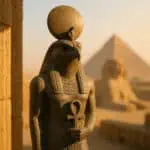
- Falcon-Headed Man with a Solar Disk: Ra is most commonly portrayed as a man with the head of a falcon or hawk, wearing a gleaming sun disk encircled by a cobra (uraeus). This form expresses his link to the sky, his solar nature, and his protective power.
- Scarab Beetle (Khepri): As the morning sun, Ra appears as Khepri, the dung beetle who pushes the sun across the sky. The scarab is a symbol of transformation, resurrection, and spiritual ascension.
- Ram-Headed Form (Atum-Re or Ra of the Underworld): In his evening or underworld manifestation, Ra often takes the form of a ram-headed deity, symbolizing his journey through the Duat and his hidden, regenerative aspect.
- Solar Barque (The Boat of Millions): Ra sails across the sky in a divine barque (solar boat), accompanied by protective deities. By day, he brings life; by night, he traverses the underworld, battling the chaos-serpent Apep, ensuring the dawn’s return.
- Symbols:
- Sun Disk – Represents divine radiance and order.
- Ankh – Signifies life and vitality, often held by Ra or bestowed upon pharaohs.
- Uraeus (Cobra) – Emblem of protection, wisdom, and divine right.
- Was Scepter and Crook & Flail – Icons of authority, governance, and divine rulership.
Together, these forms and symbols serve not only as artistic representations but also as spiritual tools—each revealing a facet of Ra’s totality, from his nurturing brilliance to his fierce protection against the forces of chaos.
Mythological Background
Key Myths and Stories
Self-Creation and the Birth of the Cosmos
In the earliest cosmogonies of Heliopolis, Ra emerges from Nun, the infinite, dark, and watery abyss of pre-creation. Through sheer will and divine speech, Ra creates himself, often described as arising from a primordial lotus blossom or an island that surfaced in the chaotic waters. He becomes the first being, and from his own essence, he gives birth to the first divine pair: Shu (air) and Tefnut (moisture), who in turn produce Geb (earth) and Nut (sky), laying the foundation for the divine genealogy of the Ennead of Heliopolis. This act of self-creation, without a consort or partner, exemplifies his singular power and his role as the primordial life force that brought the universe into being.
The Solar Voyage and the Battle Against Apep
Ra’s most iconic myth is his daily journey across the sky in his solar barque, known as the Mandjet (Morning Boat) and Mesektet (Evening Boat). At dawn, Ra rises as Khepri, the scarab god of transformation. By midday, he radiates in his full glory as Ra, and as the sun descends, he transforms into Atum, the aging sun. At night, Ra voyages through the Duat (Underworld), where he confronts the chaos serpent Apep (Apophis)—a force of destruction and disorder.
Every night, Ra battles Apep, often aided by gods like Set, Bastet, or the divine oarsmen. This myth is not merely a cosmic allegory, but a spiritual truth for the Egyptians: the sun’s return each morning is a victory of Ma’at (cosmic order) over Isfet (chaos). The ritual reenactment of this voyage was central to temple practices, ensuring that life would continue, crops would grow, and the kingdom would remain in balance.
The Eye of Ra: Wrath and Mercy Embodied
Ra’s immense power is further personified in his “Eye”—a divine aspect of his will, wrath, and protection. The Eye of Ra often takes the form of goddesses such as:
- Hathor: As a loving mother and goddess of joy, love, and music.
- Sekhmet: As a lioness of vengeance, unleashed upon humanity when they rebelled against Ra. In one myth, Sekhmet nearly wipes out humanity until tricked into drinking dyed beer and pacified.
- Bastet: Transitioning from a lioness to a domestic cat, representing both ferocity and healing.
These forms of the Eye serve as manifestations of divine feminine energy, capable of both destroying chaos and nurturing creation. Through them, Ra enacts judgment, compassion, and balance.
The Aging of Ra and Rise of Humanity
A lesser known but telling myth speaks of Ra growing old, with humans beginning to mock and rebel against his authority. Disappointed by this disobedience, Ra sends the Eye in the form of Sekhmet to punish them. This story reflects both the divine separation between gods and humans and the cycles of renewal and balance that Ra must maintain. Eventually, Ra withdraws to the sky, riding upon the back of the celestial cow Nut, allowing other gods to rule in his stead—though his influence remains eternal.
Relationships
Ra is not only a singular creator but also a divine patriarch whose presence flows through the genealogies and identities of other gods:
- The Father of the Ennead: Through his offspring Shu and Tefnut, Ra becomes the grandfather of Osiris, Isis, Set, and Nephthys—some of the most pivotal figures in Egyptian mythology.
- Ra and Horus: Ra is sometimes merged with Horus, the falcon sky god, as Ra-Horakhty (“Ra, Horus of the Horizons”). In this form, he becomes the sun rising over both east and west, embodying both regal authority and celestial vision.
- Amun-Ra: During the New Kingdom, Ra’s identity was merged with Amun, a once-hidden creator god of Thebes, forming Amun-Ra, the supreme deity of Egypt. This fusion signified the theological and political unification of Heliopolitan and Theban power, crowning Ra as both unseen source and visible presence.
These relationships show Ra’s ability to evolve, assimilate other divine functions, and remain central in an increasingly complex religious landscape.
Role in Mythology
Ra stands as the divine monarch of heaven; a solar sovereign whose rule ensures the integrity of all life. His very existence sustains Ma’at, the ancient Egyptian principle of truth, harmony, and cosmic order. His daily journey is more than a movement across the sky—it is the heartbeat of existence, a cosmic pulse affirming that light will overcome darkness, that life can return after death, and that the divine order must be protected.
Ra is not a distant, passive god—he is an active guardian, a resilient elder, and a spiritual light that burns away chaos. By embodying cyclical renewal, he teaches that destruction is not the end but the prelude to transformation.
In essence, Ra is the eternal axis upon which Egyptian cosmology turns—a father to the gods, a warrior against chaos, a symbol of resurrection, and a beacon of divine justice.
Festivals Celebrating Ra
Throughout ancient Egypt, festivals honoring Ra marked both celestial events and seasonal rhythms that shaped the people’s religious and agricultural lives. These celebrations were more than acts of worship—they were ritual renewals of cosmic order, public affirmations of community, and opportunities to engage with the divine light of the sun god. Below are three major festivals where Ra was central to the mythic and ceremonial landscape.
Wepet-Renpet (Opening of the Year)
Timing: Mid-July, aligned with the heliacal rising of Sirius and the inundation of the Nile
Themes: Rebirth, renewal, fertility, cosmic alignment
The Wepet-Renpet—literally “Opening of the Year”—was the most important New Year celebration in ancient Egypt. It marked the reappearance of Sirius (Sopdet) in the dawn sky and the life-giving flood of the Nile, both seen as celestial signs of Ra’s rebirth and the earth’s annual regeneration.
This festival had deep solar significance: the return of Sirius, Ra’s daughter or celestial herald in some myths, heralded the renewed strength of the sun and a fresh cycle of creation. Priests performed dawn rituals in temples, pouring libations of sacred water symbolizing Nun, the primordial waters from which Ra first rose.
Celebratory rites included:
- Grand processions of solar barques carried through temple courtyards and streets.
- Feasting and music to honor the gods and the abundance to come.
- Invocation of Osiris and Horus, who worked with Ra to maintain the divine balance.
- Fertility rites and agricultural blessings, ensuring strong crops for the year ahead.
Wepet-Renpet was a moment of cosmic recalibration, where Ra’s light reaffirmed life and creation against the forces of chaos and barrenness.
Festival of the Sun (Ra’s Day Celebrations)
Timing: Regular observances, with peaks during solstices and equinoxes
Themes: Solar power, divine order, cosmic protection
The Festival of the Sun was a series of cyclical rituals and observances held throughout the Egyptian year, particularly during seasonal turning points such as the summer solstice—when Ra’s power was at its zenith.
Temples dedicated to Ra or his syncretized forms, such as Ra-Horakhty or Amun-Ra, would hold sunrise rites, where offerings were made to Ra’s solar image or sacred statue. These statues were often placed aboard ceremonial barques that were carried or floated in ritual procession, echoing Ra’s daily journey across the sky and his nightly passage through the Duat.
Key features of the Festival of the Sun included:
- Communal sunrise prayers, facing east as the sun rose over the horizon.
- Offerings of bread, beer, flowers, and incense, symbolic of nourishment and praise.
- Hymns and dances performed by temple musicians and singers.
- Solar invocations, requesting Ra’s continued favor and protection for the land, its rulers, and its people.
These rites were not only acts of devotion but reaffirmations of Ma’at, the divine order, reminding all that Ra’s light sustains balance, life, and truth.
The Beautiful Feast of the Valley (Heb Nefer en Ipet)
Timing: Late spring/early summer (usually during the harvest season)
Themes: Ancestor reverence, funerary renewal, divine presence
While primarily associated with Amun of Thebes, the Beautiful Feast of the Valley also honored Ra as a guiding light for the dead and a symbol of rebirth beyond the grave. During this festival, the sacred barque of Amun-Ra was transported from Karnak Temple across the Nile to the west bank, where necropolises and mortuary temples lay.
Here, the living communed with the dead in joyful remembrance, sharing meals at tomb sites and invoking Ra’s illuminating presence to bless the spirits of ancestors and ensure their continued journey through the afterlife.
Ritual elements included:
- Torch-lit night processions, symbolizing the sun’s descent into the Duat.
- Chants invoking both Amun and Ra, as dual aspects of divine light.
- Ancestral offerings of food, flowers, wine, and sacred oils.
- Feasting among the tombs, a rare blending of sacred and domestic life.
Ra’s role in this festival was subtle but profound—his light was the bridge between life and death, his barque the vessel by which souls moved through darkness toward rebirth.
Together, these festivals reflect the multifaceted worship of Ra: as a creator god, a solar guardian, and a divine protector of the living and dead. Each celebration served to strengthen communal bonds, renew cosmic balance, and align human life with the eternal rhythms of the sun.
Ritual Practices Associated with Ra Worship
Ritual devotion to Ra in ancient Egypt was deeply embedded in temple life, statecraft, and daily rhythms. These practices were not only ceremonial acts of piety but sacred reenactments of cosmic cycles, reinforcing the divine order of Ma’at. Worshippers, particularly the priesthood, sought to sustain Ra’s energy and favor through offerings, purification, music, and art—each an essential thread in the tapestry of sun devotion.
Daily Temple Rituals: A Cycle of Divine Sustenance
At the heart of Ra’s worship were the daily temple rituals, meticulously timed to reflect the sun’s journey—dawn, zenith, and dusk—each phase seen as a unique aspect of Ra: Khepri (the rising sun), Ra (the noonday force), and Atum (the setting sun).
Ritual sequence included:
- Opening the Shrine: At dawn, the high priest would approach the inner sanctuary, intone sacred hymns such as “Awaken in Peace, Great God”, and break the seals of the god’s naos (shrine).
- Cleansing the Deity’s Image: The statue of Ra (or Ra’s syncretic form, like Amun-Ra) was ritually washed with purified water, anointed with oils, and dressed in fresh linens, renewing its divine essence.
- Offerings of Sustenance: Priests laid out elaborate offerings of bread, beer, wine, fruits, incense, and symbolic goods. These were believed to nourish Ra’s ka (life-force) and, by extension, the cosmos.
- Recitation of Hymns and Litanies: Each ritual was accompanied by meticulously memorized prayers, often praising Ra’s journey, cosmic authority, and protective power.
- Burning of Incense: Sacred resins like frankincense and kyphi were burned to purify the temple and elevate the ritual atmosphere.
These rites were repeated three times daily, mirroring the solar cycle and maintaining the balance between the mortal world and the divine.
Priesthood and Temple Culture: Embodying Ma’at
The priesthood dedicated to Ra adhered to strict codes of ritual purity, as they were seen not merely as caretakers of temples, but as vessels of divine order.
Duties and customs included:
- Daily purification rituals: Priests bathed several times a day, shaved their bodies to avoid impurity, and wore linen garments, symbolizing light and cleanliness.
- Observance of Ma’at: Every act within Ra’s temple was meant to uphold Ma’at—truth, balance, and cosmic harmony. To falter in ritual precision was to invite spiritual imbalance.
- Performance of the Fire Ritual: At dawn, priests performed a symbolic ignition of the sacred flame, representing Ra’s rebirth from the underworld and his victory over Apep. This fire was kept burning as a living manifestation of divine light.
High-ranking priests, such as the Hem-netjer-tepy (“chief of the god’s servants”), held administrative and spiritual authority over temple functions, ensuring both the majesty and continuity of Ra’s worship.
Music, Dance, and Art: Celebrating the Solar Divine
Artistic expression was not ornamental—it was essential to religious life. In Ra’s temples, music and movement became living prayers, designed to awaken the divine presence and honor the sun’s cycle.
Music and Chanting:
- Priestesses and musicians, especially the chantresses of Ra, performed sacred hymns, invoking Ra’s many forms and praising his attributes.
- Instruments like sistra (rattles), drums, harps, and flutes were played in rhythmic devotion, resonating through the temple halls to raise energy and elevate sacred space.
Ritual Dance:
- Dances were choreographed acts of solar storytelling, often performed in festivals and daily rituals.
- These movements were meant to mimic Ra’s journey across the heavens, or his battle against Apep, reinforcing the cosmological drama and inspiring awe among worshippers.
Art and Temple Decoration:
- Temples were adorned with vivid frescoes, golden reliefs, and colossal statues of Ra with a falcon head and solar disk, asserting his power and majesty.
- Ceilings were often painted with astronomical maps and the solar barque, while walls depicted scenes from the Book of the Day and the Book of the Night, illustrating Ra’s celestial voyage.
Even the architecture itself reflected solar theology: many temples were aligned with solar events, such as solstices or equinoxes, so that Ra’s rays would pierce the sacred chamber at precise moments—merging sky and stone in divine unity.
Together, these rituals formed a living mythological world where every sunrise was a miracle, and every rite performed ensured the sun’s rising once more. Ra’s devotees did not merely worship the sun; they participated in the continual unfolding of creation, offering music, flame, purity, and prayer as gifts to the eternal lord of light.
Symbolism & Cosmology
The ancient Egyptians were a people deeply attuned to pattern, balance, and celestial rhythm, and no force embodied these principles more vividly than the sun. In Ra, they found not only a deity but the very essence of existence—a luminous thread tying together life, death, rebirth, and cosmic order. His imagery, movements, and mythic battles carried layers of meaning that shaped theology, statecraft, and daily survival.
Iconography: Images of Radiant Power
Ra’s depictions are some of the most iconic in all of Egyptian art, instantly recognizable and rich with layered symbolism. Each form and emblem conveys a facet of his cosmic role:
- Falcon-Headed Man: Echoing Horus, this image shows Ra crowned with a sun disk encircled by a cobra (uraeus)—a symbol of divine royalty and protective fire.
- Solar Disk: Placed above his head or at the heart of temples, the sun disk represents the divine spark, the eye of creation, and the radiant force that fuels the world.
- Ankh: The symbol of eternal life, often carried by Ra or offered by him to pharaohs, emphasizing his role as the giver of breath and vitality.
- Scarab Beetle (Khepri): In morning depictions, Ra appears as a scarab rolling the sun across the sky, representing rebirth, transformation, and emergence from chaos.
- Ram-Headed Man (Af or Atum-Ra): In underworld scenes, Ra may take on a ram-headed form, guiding his barque through Duat (the underworld), invoking mystery, resurrection, and hidden strength.
These symbols were not static—they moved with the sun’s journey across the sky and through the Duat, presenting Ra as both radiant sovereign and tireless warrior, reborn daily to uphold Ma’at.
The Sun as Life Force: Agricultural and Existential Vitality
To ancient Egyptians, the sun was not abstract divinity—it was bread, river, time, and breath. Ra’s rays sustained the fields, warmed the Nile’s banks, and dictated the rhythms of labor and leisure.
- Agricultural Symbiosis: The sun’s ascent paralleled the sprouting of crops; its zenith brought ripening; its descent marked the harvest. Without Ra’s light, the Nile’s fertile gift would remain dormant, and famine would ensue.
- Daily Assurance of Continuity: Ra’s reappearance each dawn was a covenant—a visible promise that chaos had not won, that Ma’at still reigned. It wasn’t just sunrise—it was reassurance.
- Cosmic Timekeeper: The sun’s movement gave structure to temple rituals, civic festivals, and funerary beliefs. Daylight hours determined when offerings were made, when priests spoke sacred names, and when souls might rise toward the divine.
Thus, Ra was not only revered as a creator god but as the sustaining essence of reality, his presence woven into every stalk of wheat and pulse of the heart.
Ma’at and Apep: The Eternal Struggle of Light and Chaos
At the core of Egyptian cosmology lies a tension between harmony and disorder, embodied by Ma’at (order, truth, balance) and Apep (Apophis), the serpent of chaos.
- Ra’s Nightly Journey: Each evening, Ra descended into the Duat, journeying through twelve gates or hours of the night aboard the Solar Barque. Here he encountered monsters, puzzles, and Apep, who tried to devour the sun and plunge the cosmos into darkness.
- Cosmic Reenactment: These mythic battles were not just stories—they were reenacted in daily rituals, with priests burning effigies of Apep or reciting incantations to aid Ra in his perilous passage.
- Maintaining Ma’at: By overcoming Apep night after night, Ra ensured the continuation of life, time, and truth. His victory at each dawn reaffirmed the interdependence of divine action and human reverence.
This cyclical conflict reflected a broader worldview: that order must be chosen and maintained, both by gods and mortals. To live ethically, to speak truth, to honor the gods—these were all ways of aiding Ra in his fight.
In essence, the symbolism and cosmology surrounding Ra are more than theological constructs—they are spiritual metaphors and existential realities, illustrating the Egyptians’ deep trust in cyclical balance. The world was not linear—it was a loop of light, a solar spiral ever returning to origin, and Ra stood as its eternal center.
Influence on Art & Architecture
Ra’s worship was not confined to rituals and prayers; it was etched into stone, painted on walls, and written in hieroglyphs that celebrated the eternal journey of the sun. The architectural and artistic legacy of Ra reflects both the grandeur of his divine power and the practical reverence for the life-giving sun.
Temples: Solar Alignments and Sacred Spaces
The construction of temples dedicated to Ra was a feat of both spiritual devotion and celestial engineering.
- Heliopolis (Iunu): Known as the “City of the Sun,” Heliopolis was the heart of Ra’s worship. Its temples and sun courts were designed with open-air sanctuaries to allow direct interaction with sunlight, a symbolic connection to Ra’s life-giving rays.
- Karnak’s Great Temple of Amun-Ra: Over time, Ra’s cult merged with that of Amun, creating a powerful solar theology. The temple complex at Karnak, with its towering obelisks and avenues of sphinxes, was meticulously aligned to solar events such as the solstices and equinoxes, allowing light to illuminate the innermost sanctuaries during key festivals.
- Obelisks as Solar Needles: Erected in honor of Ra, obelisks were monuments of light, designed to capture and reflect the sun’s rays. Their tips were often gilded to shine at dawn and dusk, acting as perpetual offerings to the sun god.
These architectural marvels not only celebrated Ra’s divinity but also served as cosmic calendars, reinforcing the sacred rhythm between humanity, the sun, and the gods.
Artistic Depictions: Ra’s Eternal Journey
Artistic expressions of Ra’s mythology were both visual prayers and cosmic narratives. From the interiors of tombs to the walls of temples, Ra’s story was immortalized in vibrant pigments and carved reliefs.
- Ra’s Solar Barque: Scenes often depicted Ra traveling across the sky by day and navigating the underworld (Duat) by night. These images emphasized the daily triumph over darkness and chaos, reassuring the living that life would continue after death.
- Ritual Scenes and Hymns: Hieroglyphic inscriptions recorded hymns to Ra, daily offerings, and invocations designed to “awaken” the sun god and secure his blessing.
- Tomb Murals: In the Book of the Dead and other funerary texts, Ra is shown in his various forms—Khepri (as the morning scarab), Ra-Horakhty (at midday), and Atum (at dusk)—symbolizing the cyclical passage of the soul.
These artworks were not simply decorative; they were portals of divine energy, believed to ensure the deceased would join Ra’s solar voyage in the afterlife.
Cultural Legacy: Beyond Ancient Egypt
The influence of Ra extended far beyond the banks of the Nile, shaping concepts of solar divinity across cultures and centuries.
- Helios and Sol Invictus: Ra’s attributes inspired later sun gods in Greek and Roman traditions. Helios, the Greek sun god, shares imagery of a radiant chariot traversing the sky, while the Roman cult of Sol Invictus mirrored Ra’s victory over darkness.
- Modern Spirituality and Art: Today, Ra’s image remains iconic, appearing in art, literature, movies, and even jewelry and tattoos, as a symbol of life, power, and enlightenment. Contemporary spiritual movements often call upon Ra’s energy during solstice celebrations, linking ancient sun worship to modern reverence for nature and cosmic cycles.
Modern Interpretations and Revivals of Ra Worship
Though millennia have passed since the golden age of Egypt, Ra’s solar flame continues to burn brightly in the hearts of modern seekers. The god who once sailed across the sky in a solar barque now travels through digital art, meditative rituals, and revived spiritual paths. Whether through reconstructionist devotion or inspired artistic homage, Ra’s presence still commands reverence and awe in contemporary times.
Neo-Egyptian Spirituality (Kemetic Revivalism)
In the modern era, particularly since the 1970s, there has been a growing movement to revive the ancient religion of Egypt, often called Kemeticism (from Kemet, the ancient name for Egypt).
- Daily Rituals and Offerings: Many Kemetic practitioners engage in sunrise and sunset prayers, offerings of bread, fruit, or incense, and the lighting of solar candles to honor Ra’s passage across the sky.
- Solar Meditation: Inspired by ancient solar theology, some incorporate solar meditations at dawn or noon, focusing on renewal, vitality, and clarity of vision—mirroring Ra’s presence at the zenith.
- Syncretic Worship: In some traditions, modern Kemetics worship Ra in his combined forms—such as Amun-Ra (hidden and revealed), or Ra-Horakhty (Ra as Horus of the Horizon)—to reflect both continuity and personal interpretation of his aspects.
- Reconstructionist Temples: Online and in-person groups such as the Kemetic Orthodoxy (House of Netjer) maintain sacred calendars, festivals, and priestly orders, with Ra often honored as the head of a divine solar lineage.
These communities strive to balance historical authenticity with modern accessibility, breathing new life into ancient rites while making them relevant for today’s spiritual practitioners.
Spiritual Appeal in the Modern World
In a time of existential upheaval, climate crisis, and digital disconnection, Ra’s archetypal domains of light, order, and renewal are more needed than ever.
- Symbol of Order Amid Chaos: Ra’s daily battle with Apep—the embodiment of chaos—resonates deeply with those who face inner or external turmoil. His triumph at each dawn offers a metaphor for resilience, perseverance, and the power of returning light.
- Inspiration for Personal Transformation: As a god of cyclical rebirth, Ra appeals to individuals undergoing spiritual awakenings, life transitions, or healing journeys. His solar energy is often invoked in rituals for clarity, growth, and illumination.
- Connection to Nature and the Cosmic Whole: Ra’s identity as the sun—universal, impartial, and sustaining—connects practitioners to planetary rhythms, seasonal awareness, and the unfolding spiral of time. This makes him a powerful ally in eco-spirituality and nature-based pagan paths.
Whether he is called upon in solitary devotion, group rituals, or seasonal festivals like the solstices, Ra continues to guide modern mystics toward inner truth and harmony with the cosmos.
Cultural Representations in Art, Literature, and Media
The legacy of Ra extends well beyond temple altars and modern rituals. He has become a fixture in popular culture, reflecting the continued human fascination with the power and mystery of the sun.
- Literature and Graphic Novels: Ra appears in fiction from Egyptian-inspired fantasy to historical reimaginings. He is portrayed as a father of gods, a cosmic force, or even a misunderstood ancient intelligence.
- Film and Television: Ra has been reimagined in pop culture through films like Stargate, where he appears as a powerful alien being with divine stature, and documentaries that explore Egypt’s sacred solar knowledge.
- Video Games and Interactive Media: In titles such as Assassin’s Creed: Origins, Smite, and Age of Mythology, Ra is a playable or reference deity, often associated with devastating light-based powers, resurrection, and creation.
- Modern Art and Symbolism: Artists and esoteric creators frequently draw on Ra’s iconography—falcon-headed deities, sun disks, scarabs, and solar boats—to convey spiritual messages, explore archetypal themes, or craft mystical visuals.
These cultural depictions, whether reverent or fantastical, keep Ra’s image alive, inviting new generations to ask ancient questions about light, order, life, and the divine.
Conclusion: The Eternal Flame of Ra
From the first glimmer of dawn over the Nile’s horizon to the final flicker of a candle on a modern altar, Ra’s journey endures.
In ancient Egypt, Ra was more than a sun god—he was the pulse of the cosmos, the spark of life in the womb of creation, and the radiant heart of a civilization that flourished under his light. His daily voyage across the sky and nightly battle through the underworld weren’t just myth—they were sacred metaphors for the rhythms of life, death, and rebirth that shaped Egyptian identity, art, and spirituality for millennia. Ra’s festivals, rituals, and temples echoed with hymns of reverence, celebrating his power to illuminate both the earth and the human soul.
Yet his story did not end with the last priest of Heliopolis or the fading echoes of sacred chants beneath Karnak’s stone columns. Ra lives on—not as a relic of a lost world, but as a guiding force in today’s spiritual awakening. In the prayers of Kemetic revivalists, in solar rites performed at dawn, in poetry and art that invoke the balance of light and dark, Ra continues to inspire. He offers us a path not only to veneration, but to understanding our place in the cosmic cycle.
To worship Ra in the modern age is to remember that we, too, rise each day against darkness, we strive toward truth, and we burn with the same sacred fire that once lit the ancient temples of Egypt. His legacy—etched in sandstone, spoken in myths, and reawakened in the hearts of seekers—remains a beacon of resilience, order, transformation, and divine light.
As long as the sun rises, Ra will rise with it—guiding us ever forward, across the sky of our own becoming.