Introduction
Sunna the Chariot-Bearer, Guardian of Daylight
In the myth-shrouded world of Norse cosmology, where frost giants clash with gods and the world tree Yggdrasil roots itself in mystery, the sun is not a burning star, but a divine force driven by the goddess Sól. Known also as Sunna, she is the shining presence in the sky whose ceaseless journey carries daylight to the Nine Realms. Her role is not one of leisure or divine splendor—it is a race for survival, as she is forever pursued by the great wolf Sköll. And yet, she rides on, a symbol of resilience, cosmic duty, and radiant clarity.
This article explores her mythology, symbolism, and the spiritual meanings she continues to illuminate in modern magical practice.

Who is Sól?
Sól, whose name means simply “Sun” in Old Norse, is the radiant goddess who drives the sun-chariot across the heavens. She is the daughter of Mundilfari, a man so proud of his children’s beauty that he named them after the sun and moon, and Glaur, about whom little is known but who may represent shimmering or glowing qualities. Her brother is Máni, the moon god, and together they govern the rhythms of time and tide in Norse cosmology.
In the ancient tales, Sól was not originally born into divinity—rather, she and her brother were placed in the sky by the gods to steer the sun and moon. The Aesir, recognizing their celestial beauty, appointed them to their roles as cosmic timekeepers. From then on, Sól’s chariot was drawn by two divine horses: Árvakr (“Early Riser”) and Alsviðr (“Very Swift”). Their manes blaze with celestial fire, and their gallop across the sky gives life to the world below. Because of the horses’ searing heat, the gods placed a shield named Svalinn (“Cooling”) between them and the earth to prevent the world from burning.
Though Norse myths often focus on thunderous conflict and martial valor, Sól’s presence is more subtle but no less vital. She is not a goddess of war or vengeance—she is the pulse of life itself. With each turn of her wheels, she nourishes crops, brings clarity, marks the hours of the day, and guides the people through their waking lives. Her movement sustains the very rhythm of existence in the Nine Realms.
Sól’s myth is filled with tension and motion. Each day, she is relentlessly pursued by the great wolf Sköll, a monstrous child of Fenrir. It is foretold that this beast will eventually catch her during Ragnarök, swallowing her whole and plunging the world into darkness. Yet even in this end-time myth, there is hope—Sól’s daughter, unnamed in the myths but mentioned in the Völuspá, will take up her mother’s path and drive a new sun into the sky after the world is reborn. This promise of light beyond doom is a powerful testament to her eternal legacy.
Depictions of Sól in ancient Norse art and poetry are more symbolic than literal. She is often represented by the solar wheel, or sun cross, and in poetic kennings as “the bright bride of heaven” or “glory of the elves.” When envisioned in modern imagery, she is usually shown as a youthful woman with golden hair, clad in flowing robes of white, gold, or flame, riding a sun-wreathed chariot through the firmament. Her head may be crowned with a radiant solar disc, and her eyes shine with an unblinking, watchful light.
Though she may be overshadowed in modern memory by the likes of Odin, Thor, and Freyja, Sól’s divine presence permeates every hour of the Norse day. She is the light that is always in motion—never resting, never conquered, even in prophecy. In this way, she symbolizes not just light and warmth, but also perseverance, cosmic order, and the promise of renewal.
To call upon Sól is to invoke clarity in the face of chaos, to seek strength through steady action, and to remember that even when the shadows loom long, the sun still rises.
Mythological Background
Sól’s story is marked by inevitability, cosmic duty, and the bittersweet beauty of transience. Her myth does not begin with celebration or divine coronation—it begins with a decree. In the Prose Edda, we are told that Sól and her brother Máni were so radiant in appearance that the gods, perhaps in awe or irritation, removed them from the mortal realm and assigned them their celestial roles: Sól to guide the sun and Máni the moon. Thus, her journey through the heavens was never a choice but a burden veiled in brilliance—a divine assignment meant to preserve the rhythm of time itself.
Each day, Sól rises in the east, pulling the solar chariot across the dome of the sky, casting light across Midgard and the Nine Realms. Her horses, Árvakr and Alsviðr, are tireless and radiant, their flaming manes the true source of the sun’s heat. It is not the chariot nor the goddess that emits warmth, but the living fire of these steeds. To prevent their searing power from incinerating the earth, the gods placed a great, magical shield—Svalinn—before the chariot, an act of divine restraint that ensures life can flourish below. Sól’s journey, therefore, is one of balance—guiding the fire of creation while holding back its destructive force.
Yet her path is never peaceful. She is relentlessly pursued by the monstrous wolf Sköll, one of the children of the giantess Angrboða and the great wolf Fenrir. Sköll chases her every day, nipping at her heels in a perpetual hunt through the sky. This eternal pursuit is more than a mythological motif—it represents a fundamental truth within Norse cosmology: light is not guaranteed. It must be fought for, protected, and carried forward despite the encroaching jaws of chaos.
This symbolism resonates deeply in a world where winter reigns long and darkness is ever-present. The Norse understood that even the sun was vulnerable, not a permanent fixture but a flame suspended between forces of life and entropy. The cycle was never static—it was always in motion, always under threat.
And yet, within the darkest prophecy—Ragnarök, the end of all things—there is a glimmer of renewal. It is foretold that during this cataclysm, Sköll will finally catch his prey, and Sól will be devoured. The sky will go dark, and the order of the cosmos will shatter. But even in this bleak vision, there is hope: Sól will leave behind a daughter, unnamed but destined to take her place. She will rise in her mother’s stead, driving a new sun across a reborn world.
This quiet but powerful moment suggests the essence of Norse spirituality—not in the denial of doom, but in the insistence that from every ending, a new beginning may emerge. Sól’s legacy is not only in her daily path across the sky but in her perseverance, in the light she carries despite inevitable darkness, and in the promise that her light will rise again.
Key Elements of Sól’s Mythological Role:
- The Solar Chariot: Her divine task as bearer of the sun.
- The Chase of Sköll: A symbol of entropy, fear, and inevitable change.
- The Shield Svalinn: The necessary moderation of power and brilliance.
- Ragnarök and Rebirth: A myth of loss and continuity, where her daughter inherits her mantle in the new world.
Sól’s myth tells us that even cosmic forces are not immune to fate—but they endure, they illuminate, and they pass their light onward. Her story is a flame in the cold, a cycle of fire and shadow that burns through the ages.
Symbols and Associations
Though often less anthropomorphized than deities in other traditions, Sól’s divine essence shines through the powerful imagery that surrounds her—symbols that remain deeply evocative not only in Norse mythology but also in modern spiritual and magical practices.
The Chariot
Sól’s golden chariot is perhaps her most defining symbol. It is not merely a vehicle—it represents the relentless motion of time, the passage of days, and the cyclical nature of light’s journey across the sky. Unlike gods who stand still and receive worship, Sól is ever-moving, ever-committed, her path both celestial and symbolic. To invoke the chariot in magical workings is to invite momentum, perseverance, and the acceptance of one’s divine duty, no matter the cost.
The Solar Horses: Árvakr and Alsviðr
Her two divine steeds, Árvakr (“Early Riser”) and Alsviðr (“Very Swift”), are embodiments of strength and determination. Their names alone suggest qualities prized in Norse culture—rising early and enduring hardship. Their fiery manes give light to the world, but they do so through effort and speed, not ease. In ritual or meditation, they serve as powerful archetypes of endurance, vigor, and purpose-driven motion.
Svalinn – The Cooling Shield
Placed between the sun and the Earth, Svalinn tempers the heat of the horses and protects life from being burned away. As such, this shield represents temperance, sacred moderation, and boundaries. It teaches that even light must be measured, that too much brilliance can destroy, and that protection is an active, divine act. Svalinn is an especially resonant image in spellwork involving emotional balance, psychic shielding, or warding against burnout.
The Sun Disc and Solar Wheel
The Sun Disc—a radiant circle—and the Solar Wheel (often shown with spokes marking seasons or days) are ancient, pan-European images of the sun’s sacred role in marking time and sustaining life. In the Norse context, they reflect not only solar energy but the unending turning of fate (Urðr), and the divine machinery that governs the heavens. These symbols carry the energy of divine order, cosmic cycles, and destiny.
The Rune Sowilo (ᛋ)
The rune Sowilo, shaped like a bolt of light or the tail of a comet, is often regarded as Sól’s spiritual fingerprint. It symbolizes:
- Illumination – lighting the way in times of confusion
- Success – triumph over darkness or adversity
- Spiritual Willpower – the inner flame that drives transformation
Drawing or meditating on Sowilo can align a practitioner with the radiance of purpose, the resilience of truth, and the cleansing fire of awakening.
Colors and Elemental Alignments
Sól’s palette is drawn from the sky itself:
- Golden Yellow – her sacred light, divine awareness, and joy
- Bright White – clarity, truth, purity, and the absence of deceit
- Vibrant Orange – vitality, movement, and the sacred spark of life
Her elemental alignments reflect her dominion and essence:
- Fire – for the sun’s radiant energy, creative spark, and transforming heat
- Air – for her soaring journey, her clarity of vision, and her untouchable elevation above the mortal world
Together, these elements represent not only her physical attributes but her metaphysical role as a being who moves through the sky yet remains spiritually central to the structure of the cosmos.
These symbols and associations form the sacred language through which practitioners and devotees can connect with Sól’s essence. Whether invoked through sun rites, marked by runes, or meditated upon in solitude, each element offers a facet of her divine brilliance.
Worship and Devotion
While Sól did not have a widespread or centralized cult like Odin or Thor, her importance was woven into the very structure of Norse cosmology. Her path across the sky was not just a visual event but a cosmic necessity, and the myths surrounding her affirmed her role as a sacred constant—a radiant force whose movement defined time, brought order, and kindled hope in a world shadowed by frost and chaos.
In the ancient world, devotion to Sól may not have taken the form of temples or priesthoods, but she was ever-present in poetic kennings, mythic cycles, and the sky itself. She was acknowledged not through petitions, but reverence—honored as the daily herald of life and motion. Her presence was less transactional and more cosmic, not a being to beg for favors, but a divine rhythm to be attuned with and respected.
Historical Glimpses
Though formal rituals to Sól are not well-recorded in the surviving Norse sources, several clues suggest her sacred significance:
- Sun images carved on stones and solar wheels etched into burial markers suggest solar veneration.
- Runestones and amulets bearing Sowilo (ᛋ) evoke solar protection and triumph.
- Skaldic and Eddic poetry place her among the most vital of celestial forces, chased but never caught—until the world ends and begins again.
Contemporary Devotion
Modern heathens, Norse pagans, and animist practitioners have embraced Sól not only as a mythological figure but as a living divine archetype whose light continues to sustain, inspire, and guide.
Common Modern Practices Include:
- Sunrise Rituals – Practitioners face east at dawn, offering silent meditation, spoken devotion, or a simple gesture of respect as the sun rises. These are particularly powerful during seasonal transitions such as the equinoxes and solstices, where Sól’s chariot marks pivotal turns in the Wheel of the Year.
- Offerings – Symbolic gifts to Sól include:
- Gold or yellow flowers such as calendula, dandelion, or sunflower
- Sun-colored stones like sunstone, amber, citrine, or clear quartz
- Bright fabric or woven wheels to honor the solar journey
These are often left outdoors where they can catch the morning light or be consumed by flame in fire-safe rituals. - Chariot and Flame Rituals – Devotional rites may involve lighting a series of candles in the shape of a wheel or arranging them to mimic a chariot’s path across an altar. Fire is invoked not just as warmth, but as motion, purpose, and transformation—the very nature of Sól herself.
- Runic Intonation and Galdr – Vocalizing the rune Sowilo (ᛋ) through chant or galdr practice can be a form of calling upon Sól’s essence. Practitioners may sing the rune while tracing it over flame, the rising sun, or on their own skin with sun oil.
- Solar Path Workings – Long walks during daylight hours, journaling at sunrise, and seasonal cleanings are all ways in which followers symbolically “ride with Sól” and reflect on their own progress through life’s sky.
Creating a Sacred Space for Sól
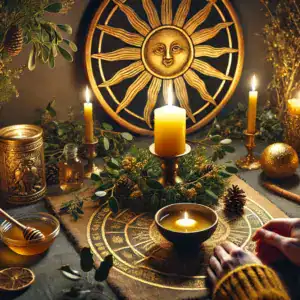
A shrine or altar for Sól is best placed in a well-lit area that receives direct sunlight at least part of the day. Even a windowsill can become a sacred hearth when aligned with intention. Elements may include:
- A golden or brass dish representing the solar disc
- Images or carvings of horses, wheels, or sunbursts
- Candles, particularly yellow, orange, or white
- The Sowilo rune engraved or drawn on a tile, stone, or paper talisman
- Seasonal offerings that reflect the brightness of day—fresh fruit, honey, or warm bread
While the Norse did not worship Sól in the structured sense seen in other pantheons, modern devotion allows for a deeper spiritual relationship with her. Through ritual, offering, and mindful connection, she is remembered not just as a myth—but as a guide, a guardian, and a flame that never falters.
Attributes and Lessons
Sól is far more than a beautiful charioteer of golden light—she is the very embodiment of steadfast duty, luminous resilience, and cosmic purpose. In a pantheon dominated by gods of war, mischief, and storm, Sól stands apart as a quiet, radiant power. She does not shout, nor does she rage. She moves with certainty across the sky, never faltering, even while the jaws of destruction snap at her heels. Her strength is not loud—but it is enduring, and it is absolute.
She is the sun’s journey given form: a perpetual motion forward, not because the path is safe, but because the path is sacred.
Though she is rarely the center of surviving Norse myths, the few stories that do speak of her carry profound truths. Sól becomes a model not just of divine responsibility, but of how mortals can move through their own darkness, carrying inner light.
Key Lessons from Sól’s Mythos:
- Hold the Light Even When Chased by Shadows
Sól is perpetually pursued by Sköll, a monstrous wolf who represents destruction, fear, and chaos. Yet she rides on. In this, she teaches the importance of perseverance—that even when threats loom close, our duty is to shine. We may not always outrun our fears, but we can outlast them by refusing to dim. - Temper Strength with Balance
The shield Svalinn is a vital part of Sól’s myth. It protects the Earth from the full force of her divine heat. Without it, the world would burn. This image reminds us that raw power—whether magical, emotional, or personal—must be moderated with wisdom. Strength without restraint is not protection, it is destruction. - Radiance is a Discipline
Unlike chaotic fire, Sól’s light is rhythmic, measured, and reliable. Her journey is not one of spontaneity but of sacred consistency. This reflects the Norse reverence for routine and duty. Her brightness comes not from fury, but from unwavering resolve. She teaches us that to be a source of light for others, we must be steady and intentional. - Legacy Matters
Though fate declares that Sól will be consumed at Ragnarök, the myth assures us that her daughter will rise in her place, continuing her journey in the renewed world. This motif of generational endurance emphasizes that true power lies not in evading death, but in shaping what comes after. Every life, every deed, every light cast into the world leaves a mark that echoes forward.
The Character of Sól
- Resolute – She fulfills her duty without fail, regardless of danger or doom.
- Protective – Her radiance brings warmth, but it is tempered to safeguard the world.
- Symbolic of Time and Season – Like the sun, she defines structure, progress, and cycles.
- Bearer of Hope – Even in her foretold end, she becomes a symbol of rebirth and continuation.
In a mythological tradition filled with volatile deities, Sól is a powerful contrast. She is not the flame that consumes, but the sun that sustains. In every dawn she rides forth, not because it is safe, but because it is right. Her myth is a call to carry our responsibilities with grace, to shine without arrogance, and to trust that even if our time ends, the light we kindle will rise again.
Magical and Spiritual Work
Working with Sól in magical practice brings the focused brilliance of the sun’s journey into your spiritual life. Her energy is steady, radiant, and precise—ideal for spells of empowerment, purification, and direction. Unlike the unpredictable blaze of wild fire deities, Sól’s power is measured and deliberate, rising with each day’s dawn and enduring even under threat. She is the guiding force of sacred light, not just illumination, but illumination with purpose.
Her power is strongest at dawn, when the world is reborn in golden light, and at solar noon, when her radiance stands at its zenith. These times offer clear windows for contacting her energy directly and setting spells into motion that seek visibility, strength, or momentum.
Magical Workings with Sól May Include:
- Solar Empowerment Spells
Call on Sól to ignite personal power, restore lost confidence, or shield your light from the shadows of doubt. These spells often involve standing in sunlight (or candlelight), invoking her name or rune, and visualizing a growing inner sun burning at your core. - Rune Magic with Sowilo (ᛋ)
Sowilo is the solar rune of clarity, honor, and success. Use it in bind-runes, carve it into candles, or chant it during sunrise rituals to draw in her unwavering will and celestial focus. Sowilo’s shape mimics the jagged burst of sunlight and connects deeply with Sól’s divine will. - Shadow Work and Solar Journeying
Like Sól pursued by the wolf Sköll, we each carry shadows that seek to overtake us. In ritual, call upon Sól to guide you through personal darkness. Use guided meditations where you visualize riding her chariot, facing your fears, and choosing to continue moving forward. - Protective Fire Circles
Inspired by Svalinn, the divine shield that tempers her heat, craft spells that establish strong boundaries without shutting down your light. Use salt, herbs like rosemary and calendula, or candles arranged in a circle to invoke Sól’s balanced fire—fierce, but never harmful. - Seasonal Rites of Continuity
At solstices and equinoxes, honor Sól as the wheel-turner. Mark your progress on the solar path, release what is no longer needed, and welcome the return or descent of light with intention and reverence.
Creating a Sacred Space for Sól
Altars and devotional spaces for Sól should be bright, open, and infused with warmth. She is a goddess of cleanliness and natural illumination. Keep her space uncluttered, filled with light, and positioned—if possible—where sunlight naturally strikes.
Consider including:
- Sun Disk or Solar Wheel – Representing the rhythm of her journey and eternal motion.
- Amber, Citrine, or Sunstone – Crystals that radiate her warmth and glow.
- Mirror or Polished Shield Token – Symbolizing Svalinn, reflecting light without burning.
- Horse Figurines or Images – To honor Árvakr and Alsviðr, her divine steeds.
- Gold and White Candles – Lit during rituals to invoke her presence with flame.
Optional additions may include solar herbs (calendula, sunflower, chamomile), solar water charged in dawn light, or a rune-stamped cloth beneath your altar tools.
Working with Sól is an act of conscious alignment. Her power is not about spectacle—it is about presence. She teaches us that strength lies in showing up, again and again, regardless of what chases us. Through ritual and magic, you can embody her essence: not just the glow of the sun, but its tireless courage, its protective warmth, and its promise of return.
Safety, Respect, and Ethical Considerations
Approaching Sól is not like basking in the comfort of a warm sunbeam—her power is that of the unrelenting dawn, of light that reveals rather than conceals. She is a goddess of sacred motion, of commitment to the path even when danger nips at your heels. Sól’s brilliance does not coddle—it clarifies. She drives her chariot across the sky each day, even knowing that the wolf Sköll pursues her. To work with her is to choose courage in the face of inevitability.
Her magic is radiant but piercing. She does not tolerate falsehood, stagnation, or spiritual laziness. When you call to her, expect your illusions to be burned away—what remains will be your raw truth, your core self. This is her blessing and her challenge.
Guidelines for Honoring Sól with Integrity:
- Invoke Her with Purpose
Sól answers those who move with intention. Call on her when you are seeking vision, truth, or strength—not for comfort or escapism. She is the solar spear, not the healing balm. Come prepared to act on the truths she reveals. - Be Willing to See Clearly
Her light does not flatter. If you invoke her presence, understand that she may illuminate aspects of yourself you’ve tried to hide—fears, flaws, long-avoided truths. This revelation is not punishment, but initiation. - Respect the Time of Day
Avoid working with Sól during the night or in deep shadow. Her energy thrives in daylight, particularly at dawn or solar noon, when her presence is at its most pure. Invoking her in darkness can feel dissonant or even jarring—like demanding growth when it’s time to rest. - Embody What You Ask For
Sól values action. Don’t simply burn a candle or recite a prayer—live her teachings. If you invoke her for clarity, pursue honesty. If you seek strength, show up and endure. Her blessings are not passive; they come through transformation. - Avoid False Promises or Vows
Do not offer what you won’t fulfill. Sól is closely tied to cosmic cycles and sacred oaths. She remembers what is said in her name and expects integrity. Let your words be gold, not ash. - Honor Her Symbols with Cleanliness and Care
Mirrors, solar disks, candles, and chariot imagery should be kept clean and charged. Let your altar reflect her brilliance—minimalist, shining, and ordered.
A Note on Emotional Readiness
Because Sól shines so directly into the soul’s hidden places, her energy can bring up strong emotional responses—especially if you’re avoiding something deep within. Be mindful of your mental and emotional state before calling her into your space. She will not harm you, but she may challenge you, and it’s best to greet that challenge with readiness rather than resistance.
If you feel overwhelmed after working with her, ground yourself with calming practices: place your bare feet on the earth, drink cool water, or sit in still shadow and thank her for what was revealed. Remember, even Sól must be tempered by Svalinn, the cooling shield that allows her light to be bearable.
Working with Sól is a sacred contract. You ask her to light your path—but that means there can be no turning away from what is shown. In return, she offers you one of the most potent spiritual tools in existence: the strength to continue moving forward. With reverence, consistency, and a heart prepared for truth, you can walk beside her chariot—and carry her flame into the future.
Conclusion
Sól, the radiant charioteer of Norse mythology, is more than a goddess of the sun—she is a cosmic presence who bears light through danger, radiance through inevitability. Her myth teaches endurance, balance, and unwavering purpose. Though her path may be chased by shadows, she rides onward each day, an eternal reminder that light must keep moving to live.
In a world that often feels like Sköll is nipping at our heels, Sól reminds us to keep shining, to press on, and to trust that even in the darkest fates, the sun will rise again.