Introduction
The Ocean’s Oracle—Divining Messages from the Sea through Shells
From the rhythmic crashing of waves to the gleam of a spiral shell glinting in the sand, the sea has always been a symbol of mystery, intuition, and ancient knowledge. Among the many ocean-based forms of divination, Conchomancy, the practice of divining using seashells—stands out for its tactile beauty and deep symbolism. Practiced for centuries in coastal cultures, this method invites the seeker to listen to the voice of the sea through patterns, placements, and the shells’ energetic messages.
Whether used to answer specific questions or explore one’s spiritual path, Conchomancy is more than fortune-telling; it is a sacred conversation with the elemental forces of water and earth, filtered through the natural artistry of mollusks.

What Is Conchomancy?
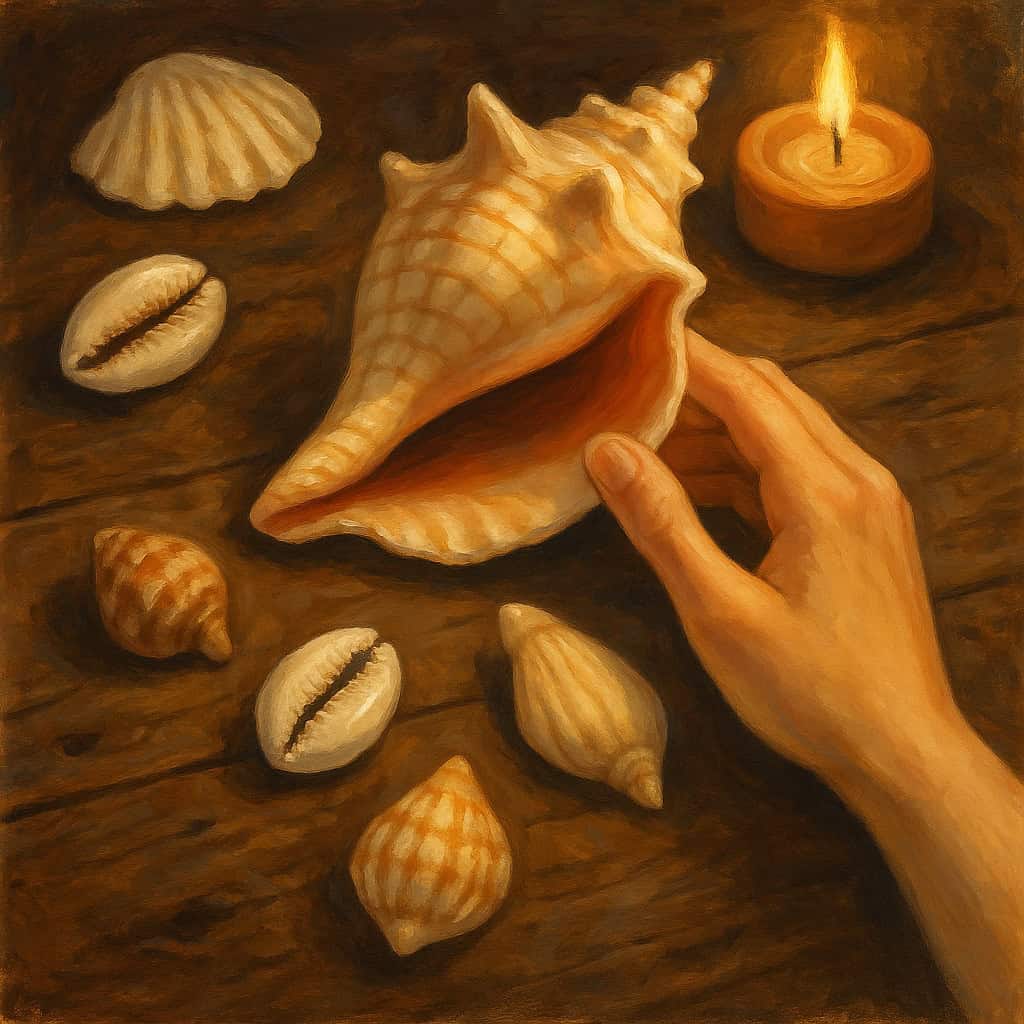
Conchomancy, sometimes referred to as seashell divination, is the intuitive and symbolic art of receiving guidance using shells, most notably cowrie shells, though other natural shells such as conches, whelks, clams, and scallops may also be used. This practice may take many forms: some practitioners toss the shells like dice to observe how they land; others draw shells from a pouch; and still others meditate with or listen to a single shell’s internal “whisper” to access intuitive messages.
Just as tea leaves may reveal a hidden pattern and tarot cards speak in archetype, the placement, shape, color, condition, and orientation of seashells become a sacred language of symbols. A single shell may represent love, protection, or a journey across emotional waters. The spread of multiple shells can tell stories of growth, loss, relationships, decisions, and transformation.
A Living Dialogue with the Sea
At its heart, Conchomancy is not merely a tool for fortune-telling—it is a dialogue between the seeker and the sea. Each shell, formed by time and tide, is considered a vessel of memory, energy, and natural wisdom. Touched by the ocean and shaped by unseen currents, a shell carries the rhythm of the water element: fluid, emotional, intuitive, and deeply feminine.
In this way, Conchomancy bridges the divide between earth and water, past and present, self and spirit. It reflects the soul of the practitioner and invites messages not just from one’s subconscious but from the greater forces of the universe—be they spirit guides, deities, ancestors, or the divine essence within nature itself.
Symbolism and Energetic Attunement
Shells are symbols of both concealment and revelation. They protect delicate life within, much as our own emotions, dreams, and vulnerabilities lie beneath our outer shells. By using these natural tools for divination, practitioners engage in a process of intuitive channeling—tuning into the subtle energies carried by the shells and interpreting their messages through feeling, imagery, and metaphor.
Because of their connection to the element of water, Conchomancy is particularly useful for exploring questions of:
- Emotional truth
- Spiritual calling
- Relationship dynamics
- Personal healing
- Divine feminine energy
It is also deeply supportive in rituals involving the moon, oceans, tides, and goddesses of the sea such as Yemaya, Aphrodite, and Amphitrite.
A Sacred Act of Listening
To practice Conchomancy is to listen—to the ocean, to nature, and to yourself. When you sit with your shells, you are not just reading symbols; you are participating in a ritual of deep presence and elemental wisdom. Whether you are casting shells in a formal divination session or simply holding one in your hand while walking the beach, the act becomes an invitation for guidance to flow from the vast, mysterious waters of the world into the sacred waters of your heart.
In a world that often rushes forward, Conchomancy invites us to slow down, breathe deeply, and hear what the sea has to say.
A Brief History of Shell Divination
Seashells, born from the ocean’s mysterious womb, have long captured the imagination of cultures across the world. Their use in divination, ritual, and magic is not confined to one region or religion—it spans centuries and continents, carried like driftwood through time by the tides of spiritual practice. Shell divination is ancient, sacred, and profoundly cross-cultural, echoing a shared belief that the sea speaks—and that shells are the language it leaves behind.
African Traditions: Voices of the Orishas and Ancestors
Perhaps the most well-documented and revered form of shell divination comes from West African spiritual systems, especially among the Yoruba people, who developed Ifá—a complex and highly respected tradition of divination. Within Ifá and related Afro-Caribbean religions like Santería (Lucumí) and Candomblé, cowrie shells (often 16 in total) are ritually consecrated and used in Dilogún divination to communicate with the Orishas, or divine forces of nature.
The cowrie’s shape—resembling a vulva or an eye—made it a potent symbol of fertility, prosperity, the divine feminine, and spiritual vision. These shells were also used as currency, further reinforcing their magical association with wealth, worth, and energetic exchange.
The diviner, known as a babalawo (male) or iyanifa (female) in Yoruba culture, throws the shells and interprets which land face-up or face-down, using a vast library of oral stories and proverbs tied to the resulting patterns, called odu. This system is intricate, sacred, and regarded as a direct dialogue with divine forces.
Pacific and Oceanic Cultures: Shells as Totems and Healers
Across the islands of Polynesia, Melanesia, and Micronesia, seashells are deeply entwined with myth, medicine, and ceremony. In many traditions, large conch shells were blown to summon spirits, announce rites, or send prayers to the gods of the sea and sky.
Smaller shells were used in initiation rites, dream interpretation, and healing rituals, especially among priesthoods and matriarchal lineages. Shells were also carried as protective amulets and considered vessels of ancestral mana (spiritual power).
The energetic resonance of shells—formed in living harmony with oceanic currents—was believed to hold information about emotional tides, weather omens, and the will of deities such as Tangaroa (god of the sea) and Pele (goddess of fire and creation).
Ancient Mediterranean: Shells in Ritual and Myth
In the classical world of Greece and Rome, shells—particularly those associated with Aphrodite (Greek) and Venus (Roman)—held sacred status. Both goddesses were mythically born from the sea, arriving onshore carried by a scallop or conch shell.
As a result, seashells became symbols of love, beauty, eroticism, and feminine divinity. They were placed on altars, worn in jewelry, and used as offerings during rituals of courtship or fertility.
Some references also suggest shells were used in augury (the interpretation of omens) and were considered gifts of the sea gods, bearing divine messages to those wise enough to read their meaning.
European Folk Magic: Weather, Love, and Luck
In early European folk traditions, particularly among cunning folk and hedge witches, shells were gathered from riverbanks, lakeshores, and beaches. These were used in:
- Weather forecasting (based on how they collected water or echoed sounds)
- Love divination (placing two shells under a pillow to dream of one’s future lover)
- Household blessings or protection (shells placed on window sills or thresholds)
In some coastal regions of Ireland and Cornwall, shell readings were said to be performed on Imbolc or Beltane, especially by women seeking insight into relationships, fertility, or marriage.
A Shared Thread of Reverence
Across all these traditions, a unifying belief emerges:
The sea is sacred. Shells are its language.
Whether used in formal rituals or quiet acts of intuition, seashells have always served as bridges between human consciousness and the greater spiritual world. They represent cycles, transformation, and the fluid nature of destiny—shaped by unseen forces and delivered to our shores like sacred messengers.
Today, when we practice Conchomancy, we are not inventing something new—we are reviving and honoring a deep and timeless tradition, echoing the wisdom of countless generations before us.
How Conchomancy Works
Conchomancy, or seashell divination, is a powerful, intuitive practice that blends natural symbolism, elemental magic, and meditative ritual. It offers insight not just into the future, but into one’s inner world, spiritual path, and connection to the sea’s mysteries. By working with shells—gifts from water, time, and life—you access the rhythms of tide and transformation within yourself.
Shell Types and Their Meanings
Each shell used in Conchomancy has its own energetic frequency, shaped by its natural origin, structure, and symbolic associations. Some practitioners are drawn to specific shells by instinct, others by traditional correspondences. Below are deeper interpretations of common types:
- Cowrie Shells
Symbolism: Wealth, divine femininity, fertility, sacred speech, protection
These shells are among the most widely used, especially in African and diasporic traditions. Their smooth, curved backs represent the womb and feminine power, while their “mouths” are believed to speak truths when cast. - Scallop Shells
Symbolism: Spiritual pilgrimage, devotion, paths unfolding
Revered in Christian and Pagan paths alike, scallops speak to those walking a spiritual road. Often associated with St. James’ Way and ancient goddess worship, they guide the seeker toward clarity and alignment. - Conch Shells
Symbolism: Awakening, sacred sound, divine announcement, empowerment
Often used as ritual trumpets, the conch is the clarion call of the divine. In Conchomancy, it may signal a need to act boldly, speak truth, or initiate change. - Clam Shells
Symbolism: Privacy, emotional security, introspection, retreat
Clams invite you to go within, to listen deeply, and to protect what is precious. They may point to boundaries needing respect, or inner truths awaiting discovery. - Whelk Shells
Symbolism: Spiraling transformation, self-inquiry, evolution
The natural spiral of a whelk reminds us of the inward and outward journey of growth. It often appears during times of personal transformation, healing, or awakening. - Oyster Shells
Symbolism: Resilience, hidden beauty, pressure becoming wisdom
Oysters teach the art of alchemy—how to turn discomfort into brilliance. When these appear, they may be encouraging you to embrace challenge, soften your defenses, or look deeper for treasure.
You may choose one type of shell to work with exclusively (such as cowries for a traditional reading), or blend a variety based on your question, ritual theme, or personal resonance.
Basic Reading Methods
There is no singular method of performing Conchomancy; the practice is versatile and adaptive, allowing you to work intuitively or follow structured techniques. Below are some of the most widely used approaches:
Shell Tossing (Shell Casting)
This method is most similar to rune or bone casting and is ideal for detailed readings.
Steps:
- Gather your shells in a cloth or pouch.
- Hold them in your hands and focus your mind on a specific question or area of your life.
- Cast them onto a ritual cloth, tray of sand, or natural surface like beach earth or river stones.
- Observe how they fall:
- Face-up shells are considered “speaking” and active.
- Face-down shells may suggest hidden messages, obstacles, or energies working behind the scenes.
- Grouped shells point to concentrated energy or influence.
- Isolated shells may refer to solitary aspects of your situation—either clarity or loneliness.
- Shells pointing toward you may indicate incoming messages or influence.
- Shells pointing away suggest release, endings, or outcomes.
You may assign meanings to quadrants of the cloth or sand, such as North for Career, East for Communication, South for Passion, and West for Emotion.
Shell Pull (Intuitive Drawing)
This is a more contemplative, oracle-style method ideal for single-question or daily readings.
Steps:
- Place a variety of shells in a shallow bowl or bag.
- Center yourself and close your eyes.
- Ask your question silently or aloud.
- Draw one, three, or more shells—depending on your layout.
- Read each shell’s message based on its symbolism and your intuitive impression.
This method is especially helpful for journaling, emotional reflection, or dream work.
Shell Listening (Spiritual Audition)
Inspired by the traditional idea of “hearing the ocean” within a shell, this practice is a form of deep listening and psychic tuning.
Steps:
- Choose a large, hollow shell like a conch, clam, or whelk.
- In a quiet space, place the shell against your ear.
- Close your eyes, breathe deeply, and allow your mind to wander into the soundscape of the shell.
- Notice:
- Emotions that arise.
- Mental images or symbols.
- Whispered thoughts or memories.
- Record these in a journal for later interpretation.
Shell listening works especially well during moon rituals, seaside meditations, or periods of emotional uncertainty.
Optional Enhancements
To deepen your Conchomancy readings:
- Anoint your shells with saltwater, moon water, or essential oils associated with the sea (e.g., eucalyptus, seaweed, rosemary).
- Cast during high tide, full moons, or sea-related festivals (like Midsummer, Lammas, or Poseidea).
- Use an ocean-themed altar to honor water spirits, merfolk, or sea deities such as Yemaya, Aphrodite, Manannán, or Sedna.
- Combine with other tools: throw shells with runes, bones, or charms for a multifaceted reading.
Symbolic Interpretations
In Conchomancy, much like tea leaf reading (tasseography) or wax divination (carromancy), the way objects naturally fall, cluster, or orient themselves reveals messages from the unseen. The position, proximity, direction, and number of shells all contribute to the final interpretation.
Shell Clustering & Placement
- Clustered Shells
Message: Connection, support, relationships, community, or collaboration.
When shells fall closely together, they point to interwoven energies—whether it’s a tight-knit group, family dynamics, or collaborative projects. This may also reflect a need to harmonize with others or pay attention to social bonds. - Isolated Shell
Message: Solitude, withdrawal, independence, or neglected matters.
A lone shell far from the rest often signals a solitary path or something being overlooked or hidden. It may also suggest an area of life that needs focus, self-reflection, or healing outside of external influences. - Shells Near the Edges
Message: Outside forces or the influence of unseen energies.
When shells fall near the perimeter of the reading area, they may indicate factors beyond your immediate control—such as spiritual energies, external influences, or approaching opportunities or challenges.
Orientation of Shells
- Face-up Cowries (open side showing)
Message: Active forces, open communication, divine messages, opportunities.
This orientation is seen as “talking” shells—open, expressive, and revealing. They indicate that the energy is present and moving, and the issue in question is ready to unfold. - Face-down Cowries (closed side showing)
Message: Secrets, inward focus, hidden influences, self-protection.
Closed shells symbolize withdrawal, protection, or mystery. Something may be hidden from view or in the subconscious. It may also suggest not everything is ready to be revealed yet. - Shells Lying on Their Sides
Message: Unstable or shifting energy, dual perspectives.
When a shell lands sideways, it may indicate ambivalence, transitions, or two sides to a situation. Pay attention to what other shells are touching it to interpret its tension or balance.
Spiral Shell Directionality
Spiral shells (like whelks or some conches) are especially significant in Conchomancy, as their natural geometry reflects cycles, growth, and spiritual movement.
- Spiral Shells Pointing Inward (toward center of the reading space)
Message: Time to turn inward. Focus on healing, shadow work, emotional processing, or spiritual reflection.
This direction suggests a call for introspection or return to the source. It may also indicate that answers lie within, not outside. - Spiral Shells Pointing Outward (away from the center)
Message: Expansion, expression, emergence, taking action.
Outward-facing spirals call attention to growth, external movement, and opportunities that lie ahead. They often appear during transitions, manifestations, or when it’s time to act. - Spirals Facing Each Other
Message: Duality, mirrored perspectives, possible conflict or harmony.
This layout can indicate a meeting of minds or a push-pull dynamic between two forces. If the shells are close, the relationship is active. If far, it may need repair.
Numerical Significance
The number of shells used or drawn can be as important as their symbolism. Each number carries unique energetic and mystical correspondences:
- One Shell – Unity, singularity, self. A pure or direct message.
- Two Shells – Balance, choices, relationships. Dual energies at play.
- Three Shells – Past, present, future. Body, mind, spirit. A triad of insight.
- Four Shells – Stability, grounding, foundation (related to four elements or directions).
- Seven Shells – Spiritual growth, chakras, initiation, or transformation.
- Nine Shells – Completion, culmination, the wisdom gained through experience.
You may also create spreads based on numerology—e.g., a 3-shell draw for divining the flow of time, or a 7-shell toss for a chakra-based energy reading.
Touch & Interaction
- Shells Touching Each Other
Message: Interaction between areas of your life. A relationship or influence that binds two concerns.
Analyze the meaning of each shell and how their interaction might change or enhance the message. - Overlapping Shells
Message: Entanglement, deep connection, or confusion.
This could suggest blended energies, such as a romance and career becoming intertwined—or a situation where clarity is needed to separate your needs from others’.
When to Use Conchomancy
Conchomancy is not confined to a single tradition or season—it is a living, intuitive art that harmonizes with the rhythms of nature, the ocean, and the soul. As a form of water-aligned divination, it becomes especially potent when practiced during times of emotional intensity, spiritual transition, or sacred observance.
New Moons and Full Moons
Why it’s powerful:
The moon governs tides, dreams, and the inner emotional world. These phases offer ideal timing for water-based divination such as Conchomancy.
- New Moons are excellent for setting intentions, exploring unseen truths, and initiating new beginnings.
- Full Moons are best for seeking clarity, harvesting insight, or releasing energetic blockages.
Reading shells under moonlight, especially near water, can greatly enhance the resonance of the messages received.
Seasonal Turning Points and Sabbats
Especially: Midsummer (Litha) and Imbolc
- Litha, or the summer solstice, marks a time of fertility, love, and abundance—ideal for questions about relationships, growth, and personal power. Sun-charged shells tossed onto warm sand or sunlit cloths bring added symbolism.
- Imbolc is a festival of purification and new beginnings. It is well-suited to exploring what needs to melt away or be nurtured into new life. Readings done in snowmelt or cool water can invoke the thawing of truth.
Engaging in shell readings during the Wheel of the Year’s transitions aligns the seeker with larger seasonal currents and archetypal change.
Personal Life Transitions
Use Conchomancy to navigate:
- The beginning or end of a romantic relationship
- A career change or relocation
- Periods of grief, renewal, or rebirth
- Identity shifts or spiritual awakenings
The sea is a timeless symbol of depth and emotion. Reading its remnants—seashells—can help bring understanding, reflection, and guidance during turbulent or liminal times.
Water Rituals and Elemental Magic
Appropriate for:
- Dream interpretation and night rituals
- Emotional cleansing or healing
- Sea or river blessings
- Ritual baths and moonwater work
Conchomancy pairs beautifully with any magical working involving the water element. It allows the practitioner to tune into intuition and emotional flow, while the shells themselves offer insight born of oceanic wisdom.
Ancestral and Deity Connection
Particularly effective when honoring or working with deities and spirits of the sea, such as:
- Yemaya (Yoruba): Ocean mother, protector of women and children
- Aphrodite (Greek): Goddess of love and beauty, born of seafoam
- Poseidon (Greek): God of the sea, earthquakes, and transformation
- Tiamat (Babylonian): Primordial ocean goddess of creation and chaos
- Thalassa (Greek): Personification of the sea’s vast consciousness
Offerings, devotions, and divination done with shells can form part of sacred communion with these deities, as well as with ocean spirits, merfolk archetypes, or sea-dwelling ancestors.
Quiet Meditation and Journaling Practices
Conchomancy can be woven into everyday practices such as:
- Morning or evening meditation
- Intuitive journaling
- Creativity rituals for artists and writers
- Shadow work or self-reflection exercises
By drawing or listening to a shell in silence, you may receive subtle messages, emotional clarity, or even poetic images that guide your day or support deeper healing.
Conchomancy in Modern Witchcraft
As the currents of traditional magic meet contemporary practice, Conchomancy has found renewed life among witches, mystics, and spiritual seekers. This form of seashell divination is not merely an old folk practice—it is a fluid, evolving art that continues to inspire through its symbolism, sensory experience, and oceanic resonance.
Integrating Shells into the Altar
Seashells make potent additions to magical altars, where they serve as both symbolic and energetic conduits:
- Offerings to oceanic deities like Yemaya, Aphrodite, Njord, or Thalassa
- Elemental representation of water in a four-quarters setup
- Spirit vessels for anchoring ancestral energies or guides
- Focus tools for meditation or emotional clarity
Shells placed around candles, ritual tools, or sacred statues can amplify the intuitive, emotional, and receptive energies of a working. Each shell, chosen with intention, becomes a tactile prayer.
As Companions in Tarot and Oracle Readings
Seashells can add depth and dimension to card-based readings:
- Shell Clarifiers: After drawing tarot or oracle cards, draw a shell to clarify energy or tone. For example, a face-down cowrie beside The Moon may emphasize confusion or secrecy.
- Card Anchors: Place shells atop specific cards in a spread to bless or seal their message.
- Pre-Reading Focus: Begin a reading by listening to a conch or holding a spiral shell to attune your intuition before drawing cards.
This fusion of elemental and symbolic systems invites a layered experience where imagery, texture, and sound all contribute to a deeper interpretation.
Ocean Magic and Water Spellcraft
Conchomancy is inherently aligned with ocean magic, which deals with emotions, cycles, tides, cleansing, and psychic depth. Seashells may be used in:
- Spells for emotional healing or letting go (throw shells into moving water as a release)
- Dream work (place them beneath your pillow or bed)
- Love or fertility spells (especially when using cowrie shells, long associated with womb magic and divine femininity)
- Protection rituals (scatter shells around the perimeter of a sacred circle or home)
Each shell acts as a personal talisman, a fragment of the sea that remembers and reflects your energy back to you.
Moon Water and Shell Synergy
Combining moon water with Conchomancy enhances the divination and manifestation potential:
- Drop shells into a bowl of moon-charged water during a full moon to ask a question or receive a dream message.
- Use shells to stir the water, infusing it with intention.
- Cleanse shells in moon water before or after readings to recharge them spiritually.
This practice binds lunar wisdom to the ocean’s memory, creating a deeply feminine, receptive energetic current.
Manifestation and Dreamwork Jars
Shells are excellent additions to manifestation jars, dream bottles, or spell pouches, especially for:
- Drawing in romantic or spiritual partnerships
- Strengthening emotional resilience
- Accessing ancestral memory or past-life echoes
- Calming night terrors or enhancing dream recall
A single cowrie or spiral shell can hold the essence of an entire working—its gentle shape whispering the sea’s secrets into the spell’s heart.
Shells for Every Witch
Not every practitioner has access to coastlines or sea shores, but that doesn’t diminish the potency of this practice:
- Coastal witches may collect shells during low tide, cleanse them in seawater, and charge them under the moon or sun. Each shell is a sacred souvenir of place and spirit.
- Landlocked witches can use ethically sourced or thrifted shells, resin reproductions, or even illustrated cards of shell images to perform Conchomancy. The shell becomes a vessel of will and spirit, regardless of its material origin.
What matters most is the energy you invest and the relationship you build with the shells. Treat them as sacred messengers—not tools to be used, but allies to be honored.
Conclusion
Conchomancy is a gentle yet profound way to connect with the wisdom of water, the rhythms of nature, and the divine within and around you. Each shell is a relic of life, shaped by time and tide, and when we invite them into our spiritual practice, we open ourselves to the ancient voice of the ocean.
The next time you walk the shore—or simply hold a shell in your palm—pause and listen. What does the sea wish to tell you? In the silence between the waves, your answer may come.