Introduction
The Ancient Roman Festival That Influenced Christmas Traditions
Saturnalia, one of the most popular and joyous festivals of ancient Rome, was celebrated in mid-December in honor of Saturn, the god of agriculture and time. The festivities, which initially lasted a single day but eventually extended to a week, marked the end of the autumn planting season and the approach of the winter solstice. The riotous nature of the festival, its themes of equality, and the suspension of social order made it the most anticipated holiday on the Roman calendar. Its customs of gift-giving, feasting, and merrymaking have left an indelible mark on many of the modern winter celebrations, including Christmas.

Origins of Saturnalia: A Celebration of Agriculture and Time
Saturnalia finds its origins deeply embedded in ancient Roman agricultural practices and the midwinter sowing season. The festival was dedicated to Saturn, the Roman god of agriculture, time, and wealth, who was believed to have once ruled over a golden age of abundance and peace. As the protector of seeds and sowing, Saturn’s association with the bounty of the earth made him a central figure in the Roman agricultural calendar, particularly during the winter months when farmers looked to ensure the fertility of the soil for the coming growing seasons. This reverence for Saturn was evident in the festival’s timing—December 17th—when the winter solstice was approaching, marking the year’s shortest day and the gradual return of sunlight and longer days.
In the early days of Saturnalia, the festival was celebrated for just one day, but as Roman society evolved, so too did the festival’s significance and length. By the late Republic (133-31 B.C.), the festivities expanded into a weeklong celebration, with public and private ceremonies beginning on December 17th and stretching through December 23rd. This gradual extension of the festival reflected the growing importance of Saturnalia in Roman life and the desire to fully immerse oneself in its joyful, chaotic, and symbolic nature.
At the heart of Saturnalia was the celebration of the end of the harvest and sowing season. For the Romans, this festival was a time to give thanks for the agricultural abundance that sustained their civilization throughout the year, while also looking forward to the promise of a prosperous year ahead. As the harvest was safely gathered, it was an opportunity to rest, revel, and perform sacred rites to honor the divine powers that governed the cycles of life and death, time, and nature.
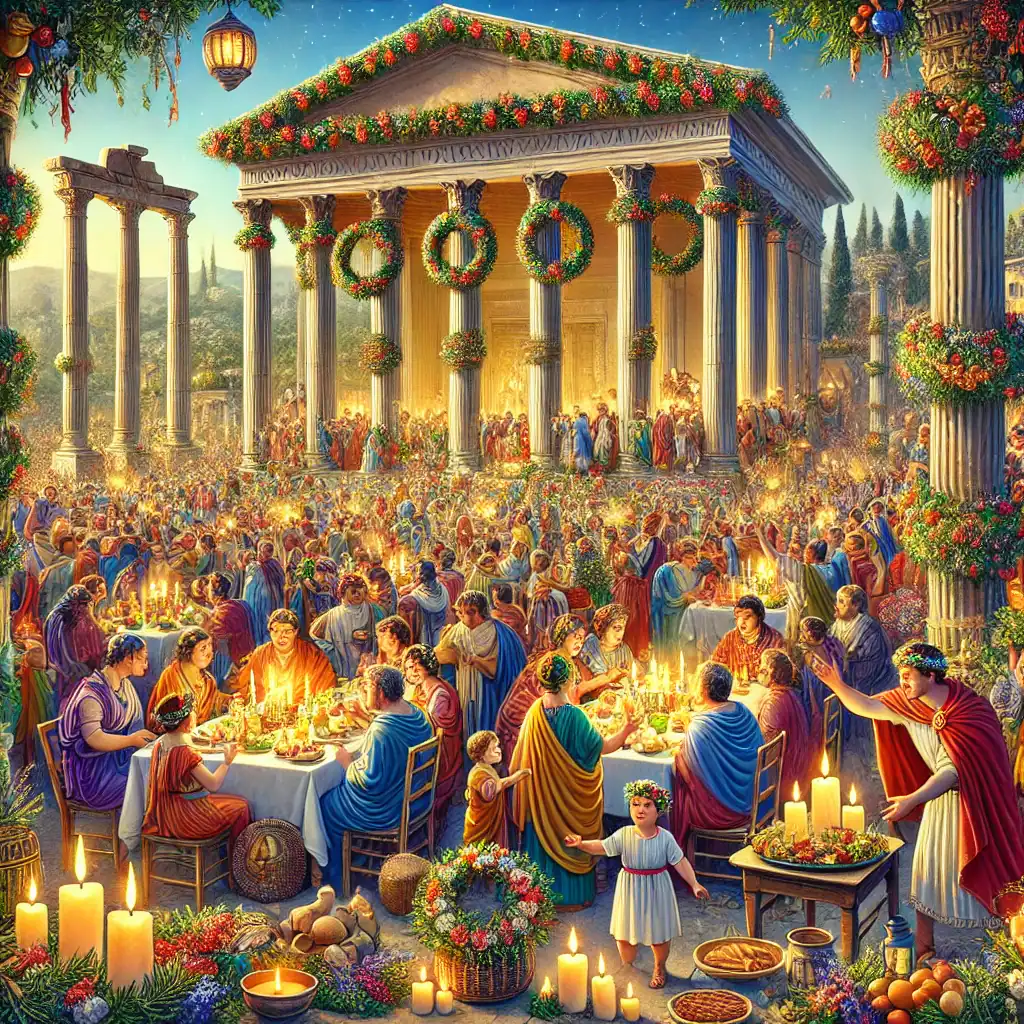
Saturnalia’s timing near the winter solstice, the darkest day of the year, also held deep symbolic meaning. The solstice represented the turning point when the sun, though at its weakest, began its journey toward greater strength. This rebirth of the sun was a hopeful promise that the cold, dark days of winter would eventually give way to spring and renewal. As such, Saturnalia was a festival of light in the darkest part of the year. The Romans would decorate their homes with wreaths, garlands, and greenery, reminiscent of the life and growth they anticipated in the coming year. Additionally, they lit candles and oil lamps to symbolize the gradual return of the sun’s warmth and life-giving power.
Saturn’s role as both a god of time and agriculture also underscored the Roman understanding of the cycles of life and nature. Just as fields lay fallow in winter to be reborn with the spring planting, so too did Saturnalia symbolize a period of rest and renewal. It was a chance to pause, look back at the past year’s labors, and contemplate the cycles of death and rebirth that governed both the natural world and human existence.
The festival not only celebrated the sun’s return but also reflected the cyclical nature of Roman life. Saturnalia’s core symbolism revolved around the idea that, like the seasons, societal roles and hierarchies could be upended temporarily to reflect the interconnectedness of all members of society. In this sense, the festival was both a release from daily norms and a reminder of the greater, natural order that governed life.
The practice of gift-giving during Saturnalia, particularly gifts of wax candles (cerei) and small clay figurines (sigillaria), is tied to these themes of light, renewal, and abundance. The wax candles symbolized the return of sunlight after the winter solstice, while the figurines may have been echoes of older rituals involving human sacrifice, now replaced with symbolic offerings that celebrated life and the divine.
Overall, Saturnalia’s origins as a celebration of agriculture and time marked a significant moment in the Roman calendar—a time of rest, joy, and reflection on the cycles of nature, society, and the cosmos. It was a festival that captured both the tangible, agricultural roots of Roman life and the deep philosophical and spiritual understandings that the Romans had of the world around them.
How the Romans Celebrated Saturnalia
During Saturnalia, normal life in Rome came to a joyous halt. Businesses, courts, and schools were closed, allowing everyone—rich or poor, enslaved or free—to take part in the festival’s revelry. The usual social structure, so strictly observed in Roman daily life, was relaxed or even overturned, reflecting the mythical Golden Age of Saturn, where all lived in harmony, without the constraints of social hierarchies. This sense of freedom and equality was one of the most defining characteristics of Saturnalia, making it one of the most anticipated and beloved holidays in the Roman calendar.
Roman homes were adorned with greenery, wreaths, and garlands, symbolic of life and renewal even in the cold, dark days of winter. Citizens set aside their traditional Roman attire—such as the stately toga—in favor of more colorful and informal garments known as the synthesis. These brightly hued robes added to the air of festivity and further highlighted the temporary relaxation of social norms.
A particularly remarkable aspect of Saturnalia was the temporary inversion of the social hierarchy. Enslaved people, who were typically expected to serve their masters in every aspect of life, were allowed a rare form of freedom. During the festival, they were invited to join the household’s feasts, sit at the head of the table, and be served by their masters. This symbolic role reversal highlighted the egalitarian ideals that the Romans associated with the reign of Saturn. According to Roman myth, Saturn’s Golden Age was a time when social distinctions did not exist, and all lived in peace, prosperity, and equality. Though this temporary reversal didn’t change the systemic inequalities of Roman society, it served as a powerful and symbolic nod to these idealized times.
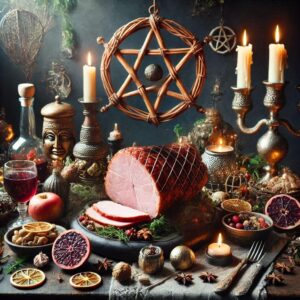
Feasting was central to Saturnalia. Tables overflowed with rich food and drink, and families and friends gathered to share in the bounty. Romans indulged in all manner of dishes, from roasted meats to sweet cakes, as a way of celebrating the end of the harvest and the abundance of the year’s agricultural efforts. The atmosphere was one of excess and indulgence, not restraint. Gambling, typically frowned upon or restricted in Roman society, became a festive activity during Saturnalia. People of all classes—patricians, plebeians, and even enslaved individuals—participated in dice games and wagering, which added to the spirit of freedom and lack of inhibition.
Gift-giving was another crucial part of the festival. One of the most popular gifts exchanged during Saturnalia was wax candles, known as cerei. These candles held symbolic meaning, representing the return of light after the solstice and the hope for longer days to come. The giving of light during the darkest part of the year was a profound reminder that the sun, and the prosperity it brought, would return.
On the final day of Saturnalia, known as Sigillaria, Romans exchanged small, terracotta figurines called sigillaria. These clay figures often depicted gods, animals, or everyday people and were given to friends and family as tokens of good fortune and well wishes for the future. Some scholars suggest that this practice may have been a remnant of an older tradition of human sacrifice, where the figurines symbolized sacrificial victims. Over time, however, this grisly custom was replaced by the more symbolic and benign act of giving these miniature representations as offerings to Saturn or as gifts to loved ones.
One of the most distinctive and entertaining elements of Saturnalia was the selection of the Saturnalicius princeps, or “Lord of Misrule.” This mock king, typically chosen from among the household’s lower-ranking members or enslaved individuals, was granted temporary rule over the festivities. The Lord of Misrule was encouraged to behave outrageously, making light of everything that was normally taken seriously. He might wear ridiculous clothing, make absurd demands, or playfully insult other guests. The chosen leader’s task was to create as much chaos as possible, upending the ordinary, strict Roman social order. This tradition reflected Saturnalia’s central theme of inversion, where the world was, for a brief time, turned upside down.
The spirit of Saturnalia was one of joyous chaos, merriment, and equality—albeit temporary. Romans embraced the festival as a time to forget their usual worries, cast aside the societal constraints of daily life, and revel in celebration. The streets and homes were filled with laughter, music, and the sound of dice rolling across tables. The atmosphere of unrestrained fun was described by Roman poets such as Catullus, who famously called Saturnalia “the best of times.” Even the most conservative Roman statesmen, like the writer and naturalist Pliny the Elder, couldn’t escape the raucous celebrations, as Pliny reportedly built himself a soundproof room in his villa so that he could continue working undisturbed while the festivities echoed through the streets outside.
Though Saturnalia may have only lasted for a week, its effects lingered, as it strengthened social bonds and reminded Romans of the cyclical nature of time, death, and renewal. It was a chance for all members of society to come together in joy, and for a brief moment, live out the ideals of the Golden Age, when there was no war, no work, and no strife. The lightheartedness and exuberance of Saturnalia left its mark on many of the modern traditions we now associate with the holiday season, making it one of the most beloved and enduring festivals of the ancient world.
Saturnalia and the Temple of Saturn
At the heart of the Saturnalia festivities was the Temple of Saturn, located in the bustling Roman Forum. This grand temple was not just an architectural marvel; it was the ceremonial epicenter of the festival, where both the public and religious elements of Saturnalia converged. The temple housed a statue of Saturn, the god of agriculture, wealth, and time, who was revered for bringing abundance and prosperity to Rome. For most of the year, the statue of Saturn was bound in woolen cloth, symbolizing the god’s restrained power and the orderly nature of the Roman world. However, during Saturnalia, these bindings were ritually loosened in a symbolic act of liberation, marking the beginning of the festivities.
This unbinding of Saturn’s statue was significant—it represented the release of the god’s energy and influence, and by extension, the loosening of societal rules and norms. This gesture set the tone for Saturnalia, a time when the social order was temporarily overturned and the constraints of daily life were lifted. It was as if Saturn himself, once freed, granted permission for chaos and joy to reign. The moment of unbinding embodied the festival’s central themes of release, freedom, and a return to the mythological Golden Age, where all people lived in harmony, free from the burdens of social hierarchy and labor.
On the first day of Saturnalia, a pig, typically a young one, would often be sacrificed at the temple as an offering to Saturn. This ritual sacrifice, known as suovetaurilia, was a common agricultural rite in Roman religious practice, reflecting Saturn’s role as the god of sowing and the harvest. By sacrificing a pig, Romans were not only offering thanks for the year’s bountiful harvest but also seeking blessings for the future. The act of sacrifice was an important communal ritual that reaffirmed the connection between the Roman people, their gods, and the earth that sustained them.
The opening ceremonies at the Temple of Saturn marked the official start of the Saturnalia festivities, but what followed was far from the solemnity of religious rites. The unbinding of Saturn set the stage for a week of revelry that spilled into the streets, homes, and every corner of Roman society. The joy and exuberance of Saturnalia were so overwhelming that even Rome’s most serious and dedicated citizens found it difficult to escape its influence. The Roman author and statesman Pliny the Younger famously built a soundproof room in his house to continue working in peace during the boisterous celebrations. This humorous anecdote highlights how the festive atmosphere permeated every aspect of Roman life, with laughter, music, and raucous noise filling the air.
Throughout the city, the sounds of Saturnalia could be heard day and night—laughter from street performers, the clattering of dice games, and the joyful shouts of friends and family celebrating together. This riotous celebration was not confined to the lower classes; even the Roman elite embraced the spirit of the festival, participating in its feasts, gift-giving, and temporary role reversals. The Temple of Saturn remained a focal point, drawing people from all walks of life who came to pay homage to the god and partake in the communal festivities that united Rome during this most beloved holiday.
The temple itself, constructed and renovated several times over the centuries, stood as a testament to Saturn’s enduring importance in Roman religious life. Originally built around 497 B.C. and later reconstructed in 42 B.C. after a fire, the Temple of Saturn was one of the oldest temples in the Roman Forum. Its towering columns and grand staircase symbolized not only the architectural prowess of the Romans but also their deep reverence for Saturn and his role in shaping the prosperity of their civilization. During Saturnalia, this grand space was transformed into a place of celebration, where Romans gathered to express gratitude for the past year’s harvest and to revel in the joy of the festival.
The festival of Saturnalia was more than just a week of feasting and games; it was a time when the very foundations of Roman society were symbolically undone, only to be restored once the festivities had ended. The unbinding of Saturn’s statue, the sacrifices, and the revelry all served as a reminder of the delicate balance between order and chaos, work and play, and life and death. As the festival drew to a close, the statue of Saturn would be re-bound in its woolen ties, symbolizing the return of the normal order, with the promise that Saturn would watch over the city and its people until the next Saturnalia arrived.
Saturnalia and Its Influence on Christmas
Saturnalia has left an indelible mark on many of the winter celebrations that we continue to observe today, especially the Christian holiday of Christmas. As the Roman Empire expanded its borders across Europe, it carried its customs and festivals along with it, influencing the cultural practices of the Celtic, Germanic, and other European peoples it encountered. One of the most notable legacies of Saturnalia is the way its traditions seamlessly merged with Christmas celebrations. Though Christmas is celebrated as the birth of Christ, the holiday owes much of its structure, symbolism, and festivity to the ancient Roman Saturnalia.
By the fourth century A.D., Christianity had become the dominant religion within the Roman Empire, but converting the population to the new faith was no easy task. The Roman Church, recognizing the deep attachment people had to their traditional celebrations, sought to ease this transition by absorbing popular pagan holidays into the Christian calendar. This process allowed pagan converts to keep many of their beloved traditions, but with new Christian meanings. Saturnalia, with its joyful feasting, gift-giving, and celebration of light during the darkest time of the year, was an ideal candidate for this process.
December 25th was officially chosen as the day to celebrate the birth of Jesus Christ, even though the exact date of his birth was unknown. This decision was not arbitrary; it was deeply strategic. In the Julian calendar, December 25th was the date of the winter solstice, a time when many cultures celebrated the return of the sun and the triumph of light over darkness. Saturnalia and other solstice celebrations revolved around these themes of light and rebirth, making it an appropriate time for early Christians to honor the birth of Christ, who was seen as the “Light of the World.”
Many of Saturnalia’s most popular customs were adopted into the Christmas celebrations. The tradition of giving gifts, for instance, was a hallmark of Saturnalia. Romans exchanged small tokens of goodwill, such as candles, wax figures, and pottery, to symbolize light and blessings during the dark winter months. This tradition of gift-giving easily transferred to Christmas, where it now commemorates the gifts of the Magi to the infant Jesus.
Feasting, too, was an essential aspect of Saturnalia and continues to be central to Christmas celebrations. During Saturnalia, Roman families and communities would gather to enjoy lavish meals, with plentiful food and drink symbolizing abundance and prosperity. This spirit of indulgence carried over into the Christian celebration, and to this day, Christmas feasts bring families and communities together in joyous gatherings.
Another tradition borrowed from Saturnalia was the use of evergreens, wreaths, and candles to decorate homes and public spaces. During Saturnalia, Romans would adorn their homes with greenery and hang wreaths as symbols of eternal life and protection. Similarly, candles and wax tapers (cerei) were given as gifts to symbolize the return of the sun after the winter solstice. This practice of decorating with evergreens and lighting candles was easily absorbed into Christmas customs, where they became symbolic of the eternal life promised by Christ and the light of hope in the midst of winter’s darkness.
In addition to Saturnalia, other Roman celebrations also contributed to the development of Christmas. Juvenalia, a Roman festival honoring the children of Rome, celebrated in December, may have influenced the child-centered aspects of Christmas. Additionally, Mithraism, a popular mystery religion in the Roman Empire, also held its own midwinter festival. The birthday of Mithra, the god of the unconquerable sun, was celebrated on December 25th, which was considered one of the holiest days of the year for Mithra’s followers. As Mithra was associated with light and truth, his birthday became an important celebration in the Roman calendar, and some scholars believe this festival may have contributed to early Christian symbolism around Christmas.
The incorporation of these customs into Christmas was not just about practical adaptation; it also served as a political and religious tool. By blending pagan traditions with Christian themes, the early Church made the new religion more palatable to the people. This approach allowed for a smoother transition and encouraged wider acceptance of Christianity without completely erasing the old ways. Over time, these pagan customs became fully integrated into Christmas celebrations, and their original associations with Saturnalia and other Roman festivals faded into the background.
Today, when we celebrate Christmas by giving gifts, feasting, lighting candles, and decorating our homes with greenery, we are participating in traditions that have roots far deeper than the Christian era. The echoes of Saturnalia can still be felt in our modern holiday celebrations, reminding us that many of our most cherished customs have evolved through centuries of cultural exchange and adaptation. Even as Christmas has taken on its own unique identity, the spirit of Saturnalia—the joy, warmth, and celebration of light in the darkest time of the year—continues to shine through
Saturnalia’s Lasting Legacy
Although the Roman Empire is long gone, many of Saturnalia’s customs remain familiar to us today. The joy, laughter, and community spirit of Saturnalia live on in the way we celebrate the winter holidays—whether through feasting, exchanging gifts, or simply enjoying the company of friends and family. The festival’s themes of equality, the turning of the seasons, and the return of the sun remind us of the power of light and warmth during the darkest time of the year.
In modern Pagan traditions, Saturnalia continues to inspire celebrations of the winter solstice and the cycles of nature. As we decorate our homes, exchange gifts, and gather together to feast and reflect, we are participating in a tradition that stretches back millennia—one that honors the turning of the seasons and the joy of community, just as the Romans did long ago.
Whether in ancient Rome or in modern times, Saturnalia stands as a celebration of life, abundance, and the hope that light and warmth will always return after the darkest days of winter.