Introduction
Greek goddess of the Moon, mistress of night’s silver path
The moon has always captivated human imagination, shaping calendars, rituals, and stories across cultures. For the ancient Greeks, the moon was more than a celestial object—it was a divine being, alive with beauty, power, and presence. That being was Selene, the goddess who personified the moon itself.
Selene is one of the most radiant figures in Greek mythology, a Titaness whose silver chariot crosses the sky each night, spreading calm and illumination across the world. Unlike Artemis, who later absorbed some of her associations, Selene was not a huntress or maiden of the wild. She was the moon incarnate: steadfast, luminous, and eternal.
In this article, we will explore Selene’s mythological role, her relationships with gods and mortals, her symbols and associations, and the ways she is honored in both ancient and modern practice. To invoke Selene is to walk in silver light—to find clarity in darkness and guidance in the eternal cycles of time.

Who is Selene?
Selene, whose very name means “Moon” in Greek, is the luminous Titaness who personifies the moon itself. She is the daughter of the Titans Hyperion (“He Who Watches from Above”) and Theia (“The Divine One”), making her the sister of Helios, the sun god, and Eos, the goddess of the dawn. Together, this radiant family represents the great celestial lights that govern the heavens—the sun, the moon, and the first blush of morning.
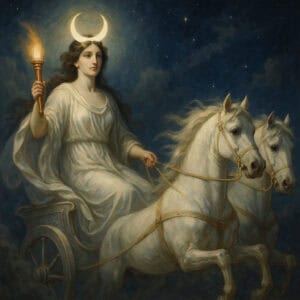
Unlike Artemis, who later became associated with lunar worship through her role as a huntress and maiden goddess, Selene is not a symbolic deity of the moon—she is the moon. Each night, she is said to ride her silver chariot across the sky, pulled by two gleaming horses (sometimes oxen, depending on the tale), her path illuminating the earth below.
In art and poetry, Selene is portrayed as a serene and radiant figure. She is often shown wearing flowing robes of pure white or soft blue, her garments trailing like veils of moonlight. Upon her brow rests a crescent moon diadem, a crown that declares her sovereignty over the night. In some depictions, she carries a torch or lantern, guiding travelers and illuminating the darkness with her gentle glow. Her chariot, drawn by Árya-like steeds with manes of silver flame, sweeps silently across the heavens, embodying both majesty and inevitability. Ancient hymns call her “rosy-fingered” and “bright-veiled,” suggesting her beauty was seen as both delicate and dazzling.
Selene’s character is gentle yet powerful. She embodies cycles of renewal, emotional depth, and the watchful care of the night. Unlike the fiery brilliance of her brother Helios, her light is soft, contemplative, and enchanting—inviting mortals to dream, to love, and to seek clarity in darkness.
She is often remembered through her many epithets, which emphasize her beauty and brilliance:
- Phoebe – “The Bright One”
- Mene – “The Measurer,” tied to her role in marking the months
- The Radiant One – highlighting her ever-present glow
But perhaps most famously, Selene is remembered through her great loves, particularly the mortal shepherd Endymion, whose eternal sleep she ensured so that she could visit him night after night. In this, she becomes not only a goddess of cycles and time but also of eternal devotion and love.
Mythological Background
Selene’s story is woven deeply into the fabric of Greek cosmology, where she embodies the eternal, cyclical dance of the moon. As the daughter of the Titans Hyperion and Theia, she belongs to one of the earliest divine lineages, representing primal forces of light and sight. Alongside her brother Helios (the sun) and her sister Eos (the dawn), Selene completes a triad of celestial deities who ensure the balance of day, night, and the transitions between them.
Unlike Helios, who is often depicted with fiery brilliance, Selene’s domain is one of subtlety and enchantment. Each night, she drives her silver chariot across the heavens, drawn by horses sometimes described as white, shining, or winged. Ancient poets imagined the dew on the grass as the foam falling from their manes. Her nightly journey ensured the illumination of the earth when Helios retired from the sky, marking the passage of time through waxing and waning phases.
The Myth of Endymion
Selene’s most famous myth centers on her love for Endymion, a mortal shepherd, king, or hunter (depending on the source). Struck by his beauty, Selene asked Zeus (or in some versions, chose herself) to place him in eternal slumber so that he might remain forever youthful. In this sleep, Endymion never aged nor died, and Selene visited him nightly in a cave on Mount Latmus to gaze upon him and, in some versions, to bear him fifty daughters—symbolizing the fifty lunar months of the Olympiad cycle. This myth captures themes of longing, stillness, and eternal devotion, and it ties Selene’s celestial role to the very rhythms of human time.
Selene, Artemis, and Hecate
Over time, Selene’s identity became closely linked with Artemis (goddess of the hunt, later associated with the moon) and Hecate (goddess of magic, witchcraft, and crossroads). Together, these three form a triple goddess archetype:
- Selene – the celestial and radiant embodiment of the moon.
- Artemis – the lunar huntress and protector of maidens.
- Hecate – the mystical, shadowed face of the moon, governing liminality and magic.
While later traditions often merged their domains, in the oldest myths, Selene remained distinct—a Titaness whose sovereignty lay not in metaphor but in the literal presence of the moon in the sky.
Epithets and Poetic Praise
Homer and Hesiod both mention Selene, describing her as “gleaming” and “bright-veiled.” The Orphic Hymns call her “bull-horned queen” and “night’s shining eye,” underscoring her cyclical horns of crescent moons and her watchful presence over the earth. These hymns emphasize her role as both nurturer and regulator, a goddess who measures months and seasons with her steady glow.
Fate and Endurance
Unlike some Olympian deities, Selene has no tale of downfall or defeat. Instead, her mythology reflects the constancy of her presence. She does not battle nor reign in thunderous glory but endures through the eternal passage of night after night. Even when later overshadowed by Artemis in popular worship, Selene’s role as the eternal lunar charioteer remained a foundation of Greek cosmology.
Symbols and Associations
Selene’s symbolism is deeply tied to the visual majesty of the moon and the imagery of her celestial role. Each of her sacred emblems reflects an aspect of her divine essence—illumination, cycles, protection, and guidance through darkness. These associations not only anchored her place in Greek myth but continue to inspire practitioners today.
Crescent Crown and Lunar Halo
Perhaps Selene’s most recognizable feature is her crescent moon crown, often shown resting upon her brow in art and poetry. The crescent signifies waxing and waning, beginnings and endings, as well as the passage of time. In some depictions, she wears a radiant halo or a full lunar disc, highlighting her dominion over all phases of the moon. These images connect her with rhythm, cycles, and the constancy of renewal.
The Silver Chariot and Horses
Selene rides across the heavens in a silver chariot, pulled by her divine horses, often described as white, glowing, or winged. Their journey represents time itself—unceasing, rhythmic, and unyielding. Poets often likened the dewfall at night to the froth and foam cast off by her steeds’ manes, making even natural phenomena a testament to her presence.
Torches of Illumination
In some depictions, Selene carries torches, symbols of guidance and clarity in darkness. The torches not only illuminate her path but also extend her role as a bringer of insight, helping mortals see beyond the shadows of uncertainty. In magical symbolism, these torches are linked with intuition, dream guidance, and divine revelation.
Colors and Elements
Selene’s colors are silver, pearl white, deep indigo, and soft blue, reflecting both the brilliance of the moonlight and the night sky she traverses. Her elemental ties are strongest with Water—for tides, intuition, and dreams—and Air, symbolizing movement, clarity, and the ethereal nature of light in darkness.
Dreams and Night Guidance
Selene has long been associated with dreams, visions, and the subconscious mind. Her light, gentle yet penetrating, was believed to touch the hearts and minds of mortals in sleep, bringing both omens and inspiration. In this way, she represents not only the physical moon but also the inner, spiritual journeys of reflection and insight.
Key Symbols of Selene:
- Crescent crown or lunar disc (cycles, renewal, and sovereignty)
- Silver chariot and radiant horses (passage of time, celestial rhythm)
- Torches (illumination, guidance, and clarity)
- Silver, pearl, and indigo colors (moonlight and night skies)
- Dreams and night visions (spiritual reflection and divine messages)
Worship and Devotion
Selene’s worship in antiquity was less institutionalized compared to Olympian deities like Athena or Zeus, but her presence was nevertheless significant, woven into hymns, offerings, and mystery traditions. Unlike Artemis, who governed the hunt, or Hecate, who ruled liminal spaces, Selene was invoked primarily as the living embodiment of the moon itself, her divine chariot lighting the heavens each night.
Ancient Worship Practices
- Hymns and Prayers: Orphic and Homeric hymns were dedicated to Selene, praising her as “bright queen” and “all-seeing eye of night.” Such hymns were often recited under the moonlight to invite her blessings.
- Offerings: Devotees left offerings of milk, honey, white cakes, incense, and fresh flowers at her altars. These represented purity, nourishment, and lunar radiance.
- Rituals at Night: Worshippers often performed rites during the full moon, seeking her light for prophecy, healing, and protection. Her presence was sometimes called upon during mystery initiations, where illumination of hidden truths was essential.
- Agricultural Ties: Farmers acknowledged her influence on the tides and the growth cycles of plants, aligning sowing and harvesting with lunar phases.
Modern Pagan and Witchcraft Devotion
In contemporary paganism and witchcraft, Selene continues to inspire rituals of light, guidance, and emotional healing. Practitioners often honor her as part of the triple lunar goddess triad—Selene (moon in the sky), Artemis (moon on earth), and Hecate (moon in the underworld).
Ways to honor Selene today include:
- Moonlight Meditations: Sitting under the full moon to absorb her radiance and seek clarity or inspiration.
- Offerings: Leaving bowls of milk, moonstone crystals, silver jewelry, or white candles on an altar to reflect her purity and brilliance.
- Dream Work and Divination: Asking Selene for guidance in dreams, or invoking her before scrying and tarot readings, especially when clarity is needed.
- Sacred Space Decoration: Altars to Selene are often adorned with mirrors, crescent moon symbols, white flowers, silver vessels, and torches or candles.
Seasonal and Cyclical Observances
- Full Moon Rites: These are the most powerful times to commune with Selene, as her light is most visible and complete.
- New Moon Reflections: While less celebrated historically, modern practitioners also seek her wisdom in times of renewal and shadow work.
- Festivals of Illumination: Some Hellenic polytheists weave Selene into broader lunar festivals, linking her with the rhythms of both agriculture and divination.
✨ Key Devotional Practices for Selene
- Recitation of Orphic or Homeric hymns under the moonlight
- Offerings of milk, honey, flowers, and white cakes
- Altars decorated with silver, mirrors, and crescent symbols
- Moonlight meditation and dream invocation
- Full moon rituals for prophecy, guidance, and clarity
Attributes and Lessons
Selene, as the radiant goddess of the moon, is far more than a celestial figure. She embodies the cycles of illumination, shadow, and renewal that govern not only the heavens but also the human spirit. Her mythology and imagery speak to the balance of constancy and change, offering lessons that resonate deeply with both ancient devotees and modern practitioners.
Illumination and Truth
Selene’s light pierces the darkness, not to banish it entirely but to reveal what dwells within it. Her glow brings clarity to confusion, wisdom to uncertainty, and a gentle reminder that truth is always accessible when sought with patience. She teaches us that illumination is not about harsh exposure but about guiding vision with compassion.
Constancy and Cycles
Unlike the erratic brilliance of fire or the storming force of thunder, Selene’s power lies in her constancy. Night after night, she returns, waxing and waning in rhythm. She teaches us to respect cycles—our moods, our growth, our setbacks—and to find reassurance in the knowledge that endings always give rise to beginnings.
Emotional Insight and Intuition
As a goddess of dreams, prophecy, and reflection, Selene nurtures our inner landscapes. Her light reveals the hidden, the unspoken, and the emotional truths often concealed by day. She reminds us that intuition is not weakness but a sacred form of wisdom, one that flows in tides like the sea she governs.
Balance of Shadow and Light
Selene does not erase the night; she coexists with it. Her presence teaches the sacred balance of light and shadow, showing us that growth requires both revelation and mystery. Just as the full moon dominates the sky and the new moon disappears into darkness, so too do our lives ebb between clarity and obscurity. The lesson lies in embracing both.
✨ Core Lessons from Selene
- Seek Illumination with Compassion: Let truth guide you without destroying gentleness.
- Honor Cycles: Growth is not linear; honor the waxing, waning, and stillness.
- Trust Intuition: Emotional wisdom is as vital as logic.
- Balance Dualities: Light and shadow, clarity and mystery, are both sacred parts of existence.
Magical and Spiritual Work
Selene’s presence is inseparable from the rhythms of magic. As the embodiment of the moon itself, she presides over enchantments of mystery, dreams, and illumination. The ancients called upon her for visions and clarity in the night, and modern practitioners continue to honor her as a guide in spells tied to lunar cycles and emotional insight.
Dreams and Prophecy
Selene’s dominion over the night makes her a powerful ally in dreamwork. Petitioners may call upon her to reveal omens, deepen dream recall, or deliver guidance through symbolic imagery. Ancient hymns invoked her “radiant torch of the night,” inviting her to shed light on hidden truths. Today, practitioners might:
- Place a silver or moonstone talisman beneath their pillow.
- Burn mugwort or jasmine before sleep.
- Invoke Selene’s name at bedtime, asking for prophetic clarity.
Healing and Renewal
As a goddess of cycles, Selene is also linked to the body’s natural rhythms, especially fertility and emotional balance. In healing rites, her energy is called to soothe grief, ease transitions, and replenish vitality. Ritual baths under the moonlight, infused with sea salt, white flowers, or lavender, are particularly effective for drawing down her restorative power.
Moonlit Spellwork
The waxing and waning of Selene’s light has long shaped the timing of magical acts.
- Waxing Moon: A time to invoke Selene for growth, attraction, and creativity.
- Full Moon: The height of her power, ideal for divination, spirit contact, and powerful manifestations.
- Waning Moon: Suited for banishing, release, and healing work.
- Dark Moon: A liminal period, when Selene’s absence symbolizes rest, introspection, and shadow work.
Ritual Practices
An altar to Selene may be adorned with silver bowls of water, white candles, and crescent-shaped symbols. Offerings often include milk, honey, or lunar herbs such as chamomile and mugwort. A polished mirror or crystal can serve as a vessel for her light during rituals, catching the moon’s reflection as a sign of her blessing.
Safety, Respect, and Ethical Considerations
Selene is not a goddess to be invoked casually. Her light is beautiful, but it is also penetrating—revealing truths that may be uncomfortable or hidden in shadow. She embodies mystery and emotional depth, and approaching her requires both reverence and readiness to be illuminated.
Approaching Selene with Reverence
Selene’s cycles demand acknowledgment. Just as the moon waxes and wanes, practitioners must honor her rhythms rather than attempt to control or bend them to personal will. Working with her means aligning with her phases—invoking her power at the full moon, reflecting during the waning, and resting during the dark moon.
Ethical Considerations
Invoking Selene is not simply about harnessing power for personal gain. She is a goddess of truth and reflection, and misuse of her energy—such as for deception, manipulation, or shallow spectacle—dishonors her. Rituals performed in her name should always seek illumination, healing, or spiritual growth.
Guidelines for Working Safely with Selene
- Be Honest – Selene reveals what is hidden. Approaching her with dishonesty or denial may backfire, drawing out truths before you are ready.
- Respect Timing – Honor her phases; do not force full-moon energy during a waning cycle.
- Maintain Purity in Ritual – Keep altars and ritual tools clean, as her association with sacred clarity demands order.
- Avoid Over-Invocation – Selene is luminous but can overwhelm; repeated, casual calling can drain or destabilize practitioners emotionally.
- Balance Light and Shadow – Do not seek Selene only for comfort. She teaches balance, which includes embracing the darker cycles of rest and release.
Cultural Respect
Selene belongs to the living legacy of Greek mythology and Hellenic spiritual traditions. While modern practitioners can respectfully adapt her worship, it is important to honor her origins—acknowledging the hymns, myths, and rituals that first carried her name.
Conclusion
Selene shines as the eternal torchbearer of the night, guiding both gods and mortals through the shifting cycles of darkness and light. Her silver chariot across the heavens is more than myth—it is a reminder of the constancy of change, the rhythm of renewal, and the illumination that lies even in the deepest shadows.
To the ancients, she was both guardian and witness, keeping watch over the world as she rode her nightly course. To modern seekers, she remains a source of inspiration and power: a goddess who embodies serenity, mystery, and emotional truth. Her lessons are timeless—she teaches us to move with grace through cycles of waxing and waning, to honor the quiet power of dreams and intuition, and to embrace both clarity and obscurity as necessary forces in life.
Selene’s gift is illumination without judgment, a steady light that reveals without burning. Whether called upon in rituals of prophecy, in moments of healing, or simply in awe beneath a full moon, she invites us to remember the beauty of reflection and the strength of constancy.
Her lasting legacy can be understood through three guiding truths:
- The Moon is Eternal – though phases pass, her presence remains unbroken.
- Light Guides Through Shadow – illumination does not erase darkness, but gives us the courage to walk within it.
- Cycles Are Sacred – every ending carries the seed of renewal.
In Selene’s glow, both ancient devotees and modern practitioners find the same truth: that the moon’s light is not just above us, but within us, guiding us to shine gently, steadily, and eternally.