Introduction
Queen of Heaven, Source of Light, and Heart of Shinto Tradition
In the light of each Japanese sunrise, a presence older than the mountains and more enduring than the sea stirs gently in the hearts of the people: Amaterasu Omikami. The great and glorious goddess of the sun, Amaterasu is not only a cosmic force but also a cultural cornerstone. She governs the skies, the spiritual hierarchy of kami, and the moral compass of Japan itself. Regarded as the divine progenitor of the Japanese Imperial Family, Amaterasu is more than myth; she is the living legacy of divinity, nationhood, and spiritual clarity.
This article explores Amaterasu’s mythological roots, her role in shaping Japanese identity, and the enduring power she holds in both ancient ritual and modern spiritual life.

Who is Amaterasu?
Amaterasu, whose name translates to “Shining in Heaven” (天照), is the principal goddess of the Shinto pantheon and the most venerated of all kami in Japanese spiritual tradition. She is the radiant embodiment of the sun’s nurturing and divine power—a source of life, illumination, and harmony. Her presence is not merely celestial but intimately woven into the identity of Japan itself. As the ancestral deity of the Imperial Family, Amaterasu stands at the heart of both mythology and nationhood, symbolizing the sacred bond between heaven, nature, and the human world.
According to the ancient Kojiki (Records of Ancient Matters), Amaterasu was born from the purified left eye of the creator god Izanagi as he performed a ritual cleansing after returning from Yomi, the land of the dead. Her birth brought light into the cosmos and established her dominion over the celestial realm, known as Takamagahara, the High Plain of Heaven. She was given authority over this realm and all beneath it, embodying the balance of sovereignty, compassion, and justice.
In Shinto practice, Amaterasu is not often represented in physical form—her presence is instead invoked through natural elements, sacred objects, and rituals emphasizing purity and reverence. However, in Japanese art and cultural imagination, she is frequently envisioned as a regal woman clothed in flowing robes of white, gold, or crimson, bearing a shining mirror or solar crown. Her demeanor is graceful yet commanding, a matron of divine light who governs not through force but through radiant presence and wisdom.
One of the most enduring symbols of Amaterasu is the Yata no Kagami (八咫鏡, “Eight-Handed Mirror”), which represents both her divine truth and the clear perception of one’s own soul. It is part of the Imperial Regalia of Japan, along with the Kusanagi no Tsurugi (sacred sword) and Yasakani no Magatama (jewel), forming the sacred triad of legitimacy and divine right.
Titles and Honors:
- Tenshō Daijin (天照大神): The Heaven-Illuminating Great Deity
- Queen of the Kami: Acknowledging her supreme role among the Shinto spirits
- Sun Sovereign of Takamagahara: Her domain is the heavenly plain, the seat of divine order
- Ancestral Goddess of the Emperor: The Japanese Emperors are said to descend from her grandson, Ninigi-no-Mikoto, reinforcing her as the spiritual matriarch of the nation
Through these many aspects and names, Amaterasu transcends her mythic origins to become a timeless archetype of inner light, clarity of purpose, and sacred leadership. Her mythos teaches that light must return even after darkness, and that justice, order, and peace are gifts nurtured through self-reflection and divine alignment.
Mythological Background
Amaterasu’s story begins with an act of cosmic cleansing—a moment that sets the stage for all life, light, and order in the Japanese spiritual cosmos. According to the ancient texts Kojiki and Nihon Shoki, the world was still forming when the primordial god Izanagi, having failed to rescue his wife Izanami from the land of the dead (Yomi), returned tainted by death’s pollution. As he purified himself in a sacred river, three powerful kami were born from his features:
- Amaterasu-ōmikami (Sun) emerged from his left eye
- Tsukuyomi-no-Mikoto (Moon) emerged from his right eye
- Susanoo-no-Mikoto (Storm and Sea) emerged from his nose
These three siblings became central figures in the celestial and terrestrial order. Of them, Amaterasu shone brightest, and Izanagi declared her the rightful ruler of the heavens—Takamagahara, the High Plain of Heaven. This elevation marks the beginning of her reign as the sovereign of light, divine justice, and harmony.
One of the most pivotal and beloved myths in Amaterasu’s lore is the Tale of the Heavenly Rock Cave (Amano-Iwato). After being cruelly harassed by her tempestuous brother Susanoo—who desecrated her sacred halls and caused chaos in Takamagahara—Amaterasu retreated into a cave in sorrow and fury. Her withdrawal plunged both heaven and earth into darkness, as her light was the source of vitality and visibility for all realms.
The other kami, recognizing that the world could not function without her, gathered outside the cave and devised a clever plan to lure her out. They hung sacred jewels and the Yata no Kagami mirror from the branches of a tree, and the goddess Ame-no-Uzume danced ecstatically, causing the gods to erupt in laughter. Curious at the sound, Amaterasu peeked out. At that moment, she saw her reflection in the mirror and was captivated. As she stepped forward, another deity quickly sealed the entrance behind her, ensuring that she could not return to seclusion.
This myth illustrates far more than an explanation for day and night. It is a powerful allegory for cycles of grief and healing, for the importance of communal joy in overcoming darkness, and for the transformational role of self-recognition. The mirror, the dance, and the laughter all speak to the deep Shinto values of harmony, beauty, and renewal.
Amaterasu’s significance does not end with the cosmos—she is the divine architect of Japan’s very identity. In another foundational myth, she chooses to send her grandson, Ninigi-no-Mikoto, down from the heavens to bring her light to earth and establish order among humans. She gifted him with the Three Sacred Treasures, now known as the Imperial Regalia of Japan:
- Yata no Kagami – the mirror, symbolizing truth and self-reflection
- Kusanagi-no-Tsurugi – the sword, representing courage and power
- Yasakani no Magatama – the curved jewel, embodying unity, prosperity, and compassion
These treasures are not mere symbols—they are living embodiments of her authority and presence on earth. With them, Ninigi established divine rule, and through him, Amaterasu’s bloodline flowed into Japan’s first emperor, Jimmu Tennō, making her the mythic ancestress of the Imperial Family.
Through these myths, Amaterasu emerges not only as the sun that warms the world but as the moral and spiritual compass of a nation, guiding emperors, illuminating creation, and ever-returning to restore what is broken. Her stories continue to be retold in ritual, drama, and celebration—reminders that light, once lost, may always be reclaimed.
Symbols and Associations
Amaterasu’s presence is not just celestial—it is deeply woven into the natural, cultural, and spiritual fabric of Japan. Every beam of sunlight, every dawn chorus, and every sacred mirror reflects her essence. As the living embodiment of the sun, Amaterasu is both immediate and eternal, her symbols infused with profound meaning that reaches beyond myth into ritual, identity, and reverence.
The most enduring and sacred of her symbols is the mirror—specifically the Yata no Kagami, or Eight-Handed Mirror. This object is said to reflect not only her divine light but also the truth of the soul. In Shinto tradition, the mirror acts as a bridge between the physical and spiritual, the seen and unseen. It is used in shrines, rituals, and even homes to evoke clarity, introspection, and purity of intention. When Amaterasu emerged from the Heavenly Rock Cave and saw her own radiant image, it was the mirror that reminded her of her essential place in the cosmos.
Other symbols intimately tied to Amaterasu include:
- The Rising Sun: The daily ascent of the sun from the eastern sea is both a literal and mythic representation of her power. It symbolizes renewal, hope, and the promise of light after darkness.
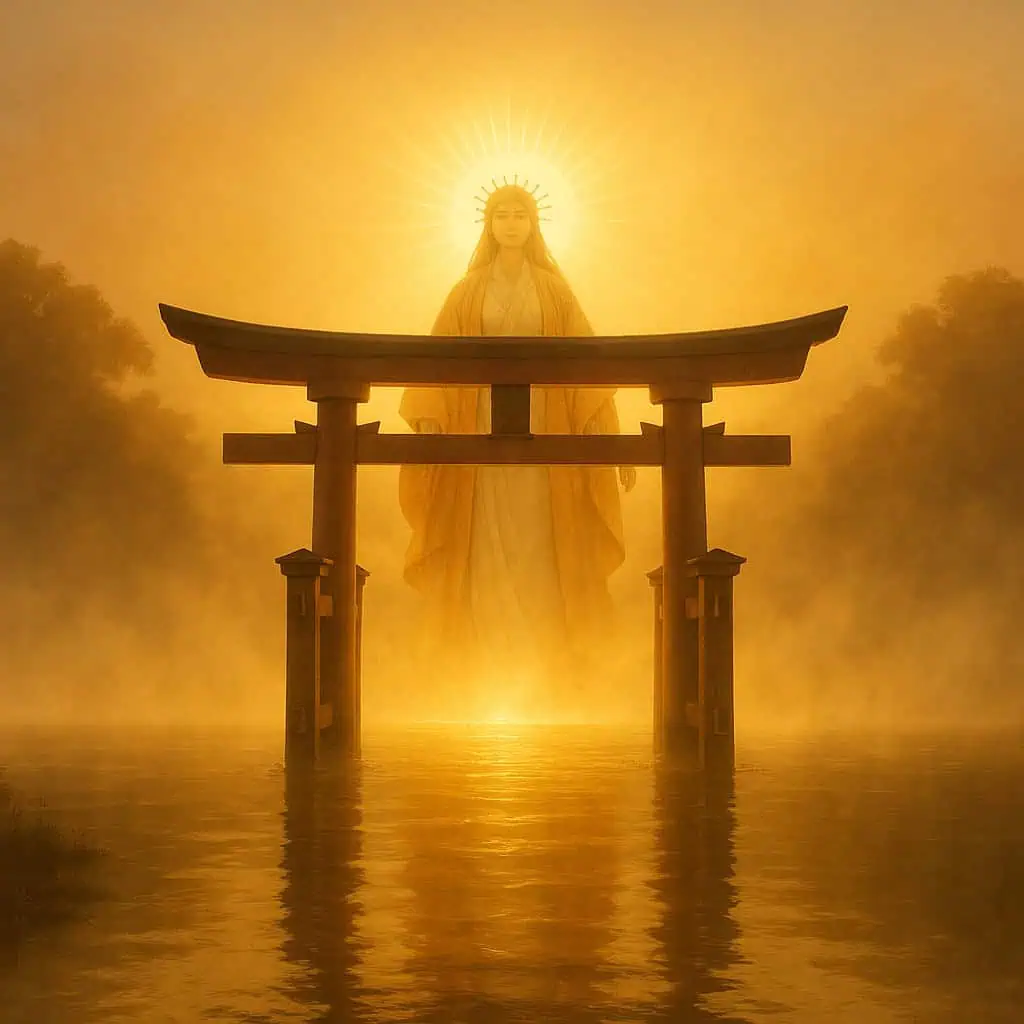
- Torii Gates: These iconic red gates, marking the boundary between the mundane and the sacred, are often aligned with the path of the rising sun. Walking through one is symbolically walking into her presence.
- White and Red: In Shinto aesthetics, white stands for purity, divinity, and truth, while red (often seen in torii and shrine adornments) represents sacred protection and life force.
- Rays and Halos: Artistic depictions often include solar radiance surrounding Amaterasu’s head or body, emphasizing her role as the source of divine light and spiritual insight.
Her elemental connections are equally telling:
- Fire: This element represents her creative and regenerative power. Like the sun, fire can warm and nourish, or scorch and purify. Fire in Amaterasu’s context is not destruction—it is illumination and transformation.
- Air: The breath of heaven, the movement of clouds, the dawn breeze that precedes the sun—all evoke her transcendent nature. Air is the carrier of divine intent and inspiration, symbolizing her omnipresence and gentle omnipotence.
More than a collection of icons, these associations reflect the lived relationship between the Japanese people and their land, their seasons, and their ancestors. Amaterasu is not a distant sun goddess—she is the radiant breath in the wind, the gleam of truth in a mirror, and the sacred hush as the first light touches shrine roofs at dawn.
Together, these symbols form a tapestry of spiritual language—one that speaks not only to the cosmos but also to the heart. They invite worshippers and seekers to walk in the light, to reflect with honesty, and to honor the sacred that surrounds and sustains all life.
Worship and Devotion
Amaterasu Ōmikami is not only the most revered kami in Shinto tradition, but she is also one of the few deities whose worship continues to shape a nation’s cultural and spiritual identity in deeply tangible ways. Her devotion is at once profoundly intimate—felt in the warmth of morning sun—and magnificently grand, enshrined in millennia-old ritual and imperial reverence.
At the heart of her veneration stands the Grand Shrine of Ise (Ise Jingū) in Mie Prefecture, considered the holiest site in all of Shinto. This sprawling sacred complex, dedicated solely to Amaterasu, is nestled within ancient cedar forests and visited by millions of pilgrims each year. It embodies the living essence of tradition, secrecy, and impermanence. Her most sacred shrine, the Kōtai Jingū, lies deep within the complex and is closed to the public, accessible only to the high priestess or priest (traditionally a member of the Imperial Family) and, on special occasions, the Emperor himself. Even the shrine’s structure reflects purity—its unpainted hinoki cypress wood is rebuilt every twenty years in a rite known as Shikinen Sengū, a monumental ceremony of spiritual and architectural renewal that has continued unbroken for over 1,300 years.
Traditional Forms of Worship Include:
- Offerings (Shinsen): Carefully prepared gifts of white rice, silk cloth, salt, sake, and seasonal foods are presented to Amaterasu in both daily rites and major festivals.
- Kagura Performances: These sacred dances, accompanied by traditional music and costumes, reenact the myth of Amaterasu’s retreat into and return from the Heavenly Rock Cave. Performed at shrines, kagura is both entertainment for the kami and a means of spiritual alignment for the people.
- Niinamesai (新嘗祭): A vital harvest festival where the Emperor offers the year’s first rice to Amaterasu, expressing gratitude for agricultural abundance and divine blessing.
- Taisai (Grand Ceremonies): Seasonal rites at Ise and other shrines mark the solstices, equinoxes, and special events in the Imperial calendar, many of which are directly tied to Amaterasu’s celestial movements.
While shrine-based rites are deeply rooted in formalized ritual, modern devotion to Amaterasu takes many forms, and continues to evolve among contemporary Shinto practitioners and spiritual seekers worldwide. Her enduring energy is sought for clarity, protection, renewal, and the sacred connection to both ancestors and cosmos.
Contemporary Practices Include:
- Sunrise Meditation and Prayer: Facing the east, devotees honor her as the dawn light breaks, offering gratitude and aligning their spirit with the rhythm of the day.
- Home Altars (Kamidana): Many homes include a small shrine shelf where Amaterasu may be honored with a mirror, rice, salt, a white candle, and simple prayers for purity and illumination.
- Seasonal Offerings: On days of personal or seasonal importance—such as New Year’s Day, equinoxes, or the summer solstice—offerings of fresh rice, sake, flowers, and incense may be left on home altars or at local shrines.
- Poetry and Devotional Writing: Amaterasu’s radiance has long inspired haiku, tanka, and prayerful verse. Writing poetry in her honor is a creative form of modern veneration.
Amaterasu’s influence also reaches beyond spiritual practice and into the very identity of Japan. Her rising sun motif adorns the national flag, her mirror remains part of the Imperial Regalia, and her story is taught in schools, celebrated in festivals, and dramatized in film and theater. She is not just a goddess to be remembered—she is a presence to be felt.
To worship Amaterasu is to enter into a relationship with the sacred rhythm of life itself: light following darkness, clarity emerging from confusion, and the hope that with each dawn, we too are invited to return to the world shining with truth, dignity, and renewed purpose.
Attributes and Lessons
Amaterasu Ōmikami is a deity of radiant dignity, luminous balance, and maternal strength. She is not a goddess of fiery wrath or stormy tempests; her power lies in her gentle constancy, her brilliant clarity, and her ability to nourish the cosmos with unwavering grace. As the source of sunlight and life itself in Shinto cosmology, Amaterasu is revered not only for her brilliance but for the compassionate order she brings to the world.
Unlike more aggressive deities of fire or dominion, Amaterasu’s rule is one of benevolence and discernment. She offers warmth without burning, illumination without blinding. Her radiance is both nurturing and judicial—a light that exposes truth and uplifts life, but also demands integrity and humility in those who walk beneath it.
One of her most profound teachings comes through the myth of her withdrawal into the cave. In this tale, Amaterasu responds to cruelty not with confrontation, but with sacred boundary-setting. Her absence plunges the world into darkness—a stark reminder of how vital her light is. Yet her eventual return, drawn out not by command but by laughter, dance, and joy, reveals another truth: that the divine can be called back through celebration, creativity, and collective ritual. It is a story of recovery, resilience, and the restorative power of community.
In her role as ancestress of the Imperial family, Amaterasu also serves as a model of leadership that flows from spiritual authority. She governs not through conquest, but through cultivation—of land, people, and ethical responsibility. Her essence lives in every grain of rice, every sunrise, every gesture of reverent care.
Key Traits and Teachings:
- Clarity and Self-Knowledge: Amaterasu’s mirror teaches us to reflect on ourselves truthfully and compassionately. Her light encourages honest self-examination and acceptance.
- Sacred Withdrawal: Her time in the cave reminds us that even luminous beings need rest, healing, and boundaries. Darkness is not defeat; it is a pause for regeneration.
- Joy as Invocation: Her return through laughter and ritual reveals that community, play, and celebration are acts of spiritual power.
- Responsibility to the Collective: As guardian of the Japanese people, Amaterasu represents leadership rooted in service, and reminds us that spiritual gifts come with civic and moral responsibility.
- Order Without Oppression: She governs the world with balanced authority, upholding harmony without domination—an ideal of compassionate rulership.
In contemporary spiritual life, Amaterasu continues to inspire those seeking inner peace, resilience, and authenticity. Her story speaks especially to those who struggle with burnout, grief, or loss of purpose—offering not only warmth and light but the reassurance that emergence from darkness is possible, and that one’s light can return even brighter than before.
To follow Amaterasu is to embrace the quiet discipline of the sun—to rise each day, even after sorrow, to shine steadily, and to bring life and order to the world around you.
Magical and Spiritual Work
Amaterasu’s presence in magical and spiritual practice is deeply rooted in purity, illumination, and balance. She is a deity who responds to sincerity, clarity of heart, and sacred discipline. Rituals that seek her aid should be marked by intentional stillness, symbolic reverence, and a focus on light’s renewing power. Her energy is not wild or chaotic—it is the soft brilliance that warms and heals, the golden fire that dispels shadow with dignity rather than force.
Devotees often seek Amaterasu when their path feels clouded, when grief or confusion has dimmed their spirit, or when they are ready to step into a brighter, truer version of themselves. She governs those liminal moments at dawn when the world is just beginning to stir—the perfect time to call upon her guidance.
Sunrise Rituals are particularly powerful. Standing in the early light with open palms or a polished mirror, practitioners may offer words of gratitude or quietly meditate on what within themselves needs to be revealed or restored. White or golden candles may be lit to mimic the gentle unfolding of the morning sun, and a shallow bowl of water can be used to reflect light into the sacred space, evoking Amaterasu’s brilliance without form.
Common Practices in Devotion and Spellwork:
- Mirror Meditations: Sit before a polished or consecrated mirror at dawn. Gaze into it gently while reciting affirmations of truth, renewal, or self-recognition. Mirrors are sacred to Amaterasu, symbolizing her light and the power of reflection.
- Light Spells: Use white or gold candles to perform spells of clarity, banishment of gloom, and truth-revealing. Speak intentions clearly and allow the flame to act as both beacon and purifier.
- Offerings of Simplicity: Amaterasu does not demand extravagance. She favors pure, humble gifts that reflect the sacredness of the everyday. Offer:
- Steamed white rice
- A cup of cold sake
- Coarse sea salt
- Clear spring water
- Clean silk or linen strips tied to trees or placed near your altar
- Sun Path Guidance: Chart the sun’s movement throughout the day and align your spells or actions accordingly—beginning spells at sunrise, invoking clarity at noon, and giving thanks at dusk.
Creating an Altar for Amaterasu involves more than decoration—it is a ritual of intention and care. The altar should be kept spotlessly clean, reflecting the goddess’s affinity for purity and order. Windows or mirrors should allow sunlight to fall upon it, reinforcing the connection to her light. Items on her altar may include:
- A round or polished mirror (Yata no Kagami representation)
- Red and white cloths: Red for vitality, white for purity
- Candles in gold holders or lanterns lit by natural flame
- Shide (zigzag paper streamers), a Shinto symbol of divine presence
- Seasonal offerings such as fresh fruit, flowers, or rice cakes
Above all, intention is everything in Amaterasu’s worship. Whether performing a simple sunrise salutation or a formal spell for inner clarity, it is your sincerity, devotion, and spiritual cleanliness that she honors.
Her magic is subtle yet deeply transformative. She does not force change; she reveals the path forward, gently lifting the veil. For witches, priests, and seekers alike, working with Amaterasu invites the warmth of purpose, the renewal of self, and the radiant certainty that light returns, always.
Safety, Respect, and Ethical Considerations
Engaging with Amaterasu is a sacred act that should be undertaken with intention, dignity, and cultural mindfulness. As the Queen of the Kami and the embodiment of divine illumination, Amaterasu is not a goddess to invoke lightly or frivolously. Her presence is majestic and serene—a cosmic force of order, clarity, and sacred responsibility. To approach her with irreverence is to turn away from the very light she offers.
Amaterasu is not wrathful in the way of storm gods or warriors. Her disappointment manifests as absence—withdrawal of favor, a dimming of inner clarity, or an emotional “eclipse.” She responds best to those who seek spiritual purity, self-awareness, and genuine gratitude. Her myths show that even she has boundaries, retreating when dishonored, and returning only when properly honored through joy, sincerity, and communal ritual.
When working with Amaterasu, keep in mind the following principles:
- Come Clean, Literally and Spiritually: Physical cleanliness and ritual purification are vital. Wash your hands and face before prayer. Burn incense or sprinkle salt water to cleanse your space. Her energy is harmonious and does not settle well in chaos.
- Timing Matters: Amaterasu is a solar deity and should be honored during daylight, ideally at dawn or morning hours. Avoid nighttime rituals in her name unless it’s part of a sunrise vigil or transition rite.
- Honesty is Sacred: As the goddess of truth and reflection, Amaterasu abhors deceit, manipulation, or falsehood. Do not lie in ritual or invoke her for dishonest gain—such efforts will turn her face away.
- Respect Shinto Culture: Amaterasu is a central figure in Shintoism, a living and deeply revered spiritual tradition in Japan. If you are outside of that tradition, take time to educate yourself and approach her with respectful integration, not appropriation.
- Don’t Demand—Invite: Amaterasu does not respond well to commands or aggressive summoning. Invite her presence with grace and gratitude, understanding that her arrival is a gift, not an entitlement.
Offerings and Behavior to Avoid:
- Avoid cluttered, neglected altars—she values beauty, harmony, and simplicity.
- Do not mix Amaterasu’s worship with chaotic or discordant spirits.
- Never use her name in binding, cursing, or shadow work. Her domain is one of light, restoration, and ethical clarity.
Working with Amaterasu is less about dramatic energy and more about refining your own spirit to become a vessel worthy of her light. Her presence uplifts, but it also exposes. She will illuminate what you need to see—whether it brings comfort or discomfort. That truth is part of her gift.
To walk in Amaterasu’s light is to commit to a path of honor, balance, and compassionate discipline. Let her be your mirror, your rising sun, and your guide toward a life of radiant purpose.
Conclusion
Amaterasu Ōmikami is far more than a solar goddess—she is the living breath of Japan’s spiritual identity, the sacred thread woven through its myths, its monarchs, and its mountains. Her brilliance reaches beyond geography and culture, shining through time as an eternal symbol of divine order, maternal wisdom, and radiant hope. In the Shinto worldview, her presence is not abstract—it is immediate, felt in every sunrise, every grain of rice offered in gratitude, and every clean-lined torii gate that leads from the mundane to the sacred.
To honor Amaterasu is to remember that light is not just something we witness—it is something we carry. Her myths do not merely explain cosmological truths; they offer blueprints for spiritual living. Her withdrawal into the cave reminds us that even the brightest spirits sometimes falter under the weight of sorrow, and her return teaches that renewal is always possible through community, joy, and ritual reverence.
Those who seek Amaterasu’s light will find in her a guide for:
- Illuminating Truth: She helps reveal inner and outer truths with clarity and compassion.
- Restoring Balance: In moments of disarray, her presence restores peace, purpose, and sacred rhythm.
- Nurturing Growth: Like the sun to the earth, her energy awakens the seeds of wisdom and spiritual maturity.
She is both distant and near—an empress among deities, yet deeply personal for those who approach with clean hands and open hearts. Her regalia may lie behind palace walls, but her spirit is found in the quiet morning, the polished mirror, the act of bowing in gratitude.
In today’s world of distraction and spiritual noise, Amaterasu stands as a beacon of quiet sovereignty and purposeful presence. She asks nothing less than our sincerity—and offers in return the strength to shine, the wisdom to lead, and the grace to reflect that which is good and true.
Let her light be the dawn in your rituals, the warmth in your convictions, and the mirror by which you see not only the divine—but yourself.