Introduction
The All-Seeing Charioteer Who Illuminates Earth and Heavens
From the dawn of Hellenic worship to the golden edges of modern mythic imagination, Helios has stood as one of the most enduring solar deities in Greek religion. More than a celestial presence, he was a witness to all things, casting his light across the earth from his blazing chariot. Though later eclipsed in influence by Apollo, Helios’s mythology remains distinct—woven with divine vigilance, cosmic movement, and radiant order.
This article explores Helios in depth: his mythological roles, symbols, spiritual significance, and modern-day relevance as a solar god who continues to inspire and illuminate.

Who is Helios?
Helios is the Greek god of the sun, one of the original personifications of solar divinity in ancient Hellenic cosmology. Long before Apollo inherited solar associations through poetic and philosophical evolution, Helios was revered as the literal and spiritual embodiment of the sun. His very name means “Sun” in Greek, and he was believed to journey across the sky each day in a resplendent chariot, bringing light, warmth, and life to all creation.
As the sun god, Helios held dominion over both time and visibility. His rising each morning heralded the beginning of the day, structuring the agricultural and civic rhythms of life. His gaze—impossible to hide from—made him an enforcer of truth, one who saw all things that transpired beneath the sky. In many ways, Helios was a guardian of cosmic order, his cycle of dawn to dusk mirroring the eternal processes of birth, life, decline, and renewal.
Though later overshadowed in the popular imagination by Apollo, Helios maintained a distinct and enduring identity, especially in older cults and in poetic, philosophical, and magical traditions where his divine light was revered not only as physical sunlight but as a symbol of inner illumination and divine truth.
In appearance, Helios is usually described as a luminous, golden-haired youth, his face radiant with divine brilliance. He is crowned with a shining solar halo or diadem, his entire being a manifestation of light. His celestial chariot is said to blaze with fire as it rises from the east, drawn by four powerful horses—each representing a different quality of light and heat—before it descends into the west and vanishes into the night.
Epithets and Titles
Over time, Helios earned many epithets that reflect his importance and character:
- Titan of the Sun – As the son of the Titan Hyperion (light) and Theia (sight), Helios belongs to the earlier, more primal generation of divine beings who shaped the cosmos.
- The All-Seeing (Panoptes) – No deed escaped his golden gaze; oaths and truths were sworn in his name because he saw all actions performed in daylight.
- Guardian of the Day – Helios was the boundary between night and day, darkness and truth. His journey upheld the day’s order and nourished crops, people, and animals alike.
- The Golden-Eyed – A poetic title speaking to both his radiant visage and his ability to pierce all illusions with his divine sight.
- Lord of the Eastern Sky – His rise from Oceanus each morning signaled divine rebirth and the coming of clarity.
- Driver of the Solar Steeds – A nod to his cosmic charioteering and mastery over the forces of illumination.
Iconography
The image of Helios is one of radiant splendor, encoded with sacred meaning and solar majesty. He is traditionally portrayed as:
- A youthful, muscular man, glowing with divine energy.
- His hair may shimmer like golden flame, often crowned with a halo, solar crown, or radiant spikes—depicting him as the source of light.
- His golden chariot is drawn by four magnificent fire-breathing horses:
- Pyrois (“Flame”)
- Eous (“Dawn”)
- Aethon (“Blazing”)
- Phlegon (“Burning”)
Helios holds a whip or reins, used to control the solar steeds, and he may also bear an orb representing his celestial dominion, or a torch signifying his role in lighting the world.
In art, he is often shown:
- Rising from the sea at dawn or descending at sunset into the underworld.
- Encircled by the zodiac, connecting him to timekeeping, astrology, and the heavens.
- On vase paintings, temple friezes, and coins, usually in regal posture, reinforcing his sovereign status.
His divine radiance frequently overlaps with esoteric and philosophical depictions of divine illumination, knowledge, and spiritual awakening, especially in later Hellenistic and Roman adaptations.
Mythological Background
Key Myths and Stories
Here’s a quick breakdown of some key myths and stories with Helio’s.
The Daily Journey of the Sun Chariot
Helios’s most enduring myth is his ceaseless daily passage across the heavens. At dawn, he emerges from the eastern waters of Oceanus in a golden chariot, drawn by four fire-breathing steeds. His path arcs across the sky from horizon to horizon, illuminating the world and separating day from night. As dusk falls, Helios descends into the western sea and is believed to travel unseen through the underworld by boat, returning eastward to rise again. This myth not only explained the sun’s movement to the ancients but symbolized the eternal cycle of renewal, death, and rebirth. His solar journey represented both divine order and the passage of time—reliable, powerful, and ever-watchful.
Helios the Divine Witness
Helios was revered not only as the embodiment of sunlight but as the all-seeing eye of divine justice. In many myths, his omniscient gaze plays a pivotal role. In the Homeric Hymn to Demeter, it is Helios who reveals the truth about Hades abducting Persephone, aiding Demeter in her search and confirming what no other god dared admit. His role as cosmic observer made him a crucial figure in oaths, treaties, and sacred bonds—those who swore falsely under his gaze invited divine retribution. His golden eyes could not be deceived, making him a deity of conscience as well as cosmology.
The Tragedy of Phaethon
One of the most poignant and cautionary myths involving Helios is that of his son, Phaethon. Desiring to prove his divine heritage, the youth implored his father to let him steer the sun chariot. Though Helios warned him of the peril, he was bound by his oath. Unable to control the divine horses, Phaethon veered too close to the earth, scorching the land and creating deserts. In response, Zeus struck him down with a thunderbolt to prevent further devastation. This tale conveys multiple layers: the dangers of pride, the awesome power of solar divinity, and Helios’s own role as a father both loving and bound to cosmic law. The scorched path left in Phaethon’s wake was mythically tied to the parched lands of Libya.
Guardian of Sacred Cattle
In Homer’s Odyssey, Helios appears as a powerful enforcer of divine law. He possesses sacred cattle on the island of Thrinacia, which Odysseus’s men are forbidden to touch. When they slaughter the animals in defiance, Helios appeals to Zeus, demanding vengeance. The ship is destroyed, and all but Odysseus perish. This tale underscores Helios’s authority and the consequences of defying his sanctity.
Light Bearer in Mystery Traditions
In later philosophical and esoteric systems—especially those influenced by Neoplatonism and Hellenistic astrology—Helios was transformed from merely a solar deity into a symbol of divine intellect and spiritual illumination. As the sun lights the material world, Helios became the light of the soul, the beacon guiding mortals toward truth, clarity, and unity with the divine. His journey through the zodiac became a metaphor for the soul’s ascent through the celestial spheres.
Relationships
Helios belongs to the primordial family of Titans, deities that predate the Olympians and rule over cosmic forces rather than mortal concerns. His lineage and descendants reflect his breadth of influence across mythology:
- Parents:
- Hyperion – The Titan of heavenly light
- Theia – The Titaness of divine sight and glittering brilliance
- Siblings:
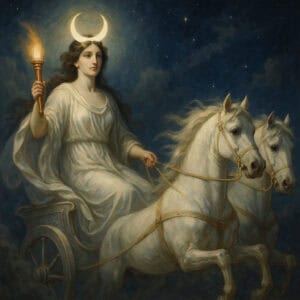
- Selene – The moon goddess, who drives her own chariot by night
- Eos – The dawn goddess, who heralds Helios’s arrival each morning
- Children:
- Phaethon – His tragic son by the Oceanid Clymene
- Circe – The powerful enchantress
- Aeëtes – King of Colchis and guardian of the Golden Fleece
- Pasiphaë – Wife of King Minos and mother of the Minotaur
These children, often born of Oceanid consorts like Clymene or Perse, represent Helios’s expansive reach across divine, magical, and royal lineages.
- Consorts:
Helios’s consorts are varied and often linked to water or magic, including:- Clymene – An Oceanid and mother of Phaethon
- Perse – A sorceress and mother of Circe and Aeëtes
- Other Oceanids or nymphs associated with light, water, or mystery
Role in Mythology
Helios occupies a unique space within the Greek mythic landscape. As the physical embodiment of the sun, he is both a celestial force and a deeply moral being. His journey establishes the rhythm of time, his gaze upholds truth, and his light is both life-giving and searing. Though he is a Titan and not an Olympian, Helios remains ever-present—watching, guiding, and illuminating.
Even as Apollo gradually assumed the poetic role of solar god, Helios was not forgotten. He endured in cult worship, art, and magic, often serving as the hidden sun—the secret flame within philosophical texts and mystery rites. In this way, Helios evolved from a Titan of light to a symbol of divine perception and spiritual clarity, bridging the realms of myth, philosophy, and mysticism.
Helios is not merely the sun—he is its soul. His mythology invites us to honor cycles, speak truth, and seek the inner light that guides us through both day and night.
Symbols and Associations
Sacred Symbols
- Sun Disk – The most prominent and universally recognized emblem of Helios is the blazing sun disk, often depicted radiating from his head like a golden crown. It represents divine illumination, clarity, and unwavering vision. The sun disk serves as both his source of power and a metaphor for his ever-watchful, all-seeing nature—casting light not only upon the earth but upon truth, justice, and hidden matters.
- Solar Chariot – Helios’s iconic golden chariot, drawn by four fire-breathing horses, is the vessel through which he traverses the sky each day. This celestial vehicle is a symbol of cosmic order, divine progress, and celestial authority. The chariot is not merely transport—it is the means by which time flows, day is separated from night, and the world is warmed and made fertile. In later spiritual traditions, the chariot also came to represent the soul’s journey through the spheres of the heavens.
- Fire-Breathing Horses – The four horses—Pyrois (Fiery), Eous (Dawn), Aethon (Burning), and Phlegon (Flame)—are embodiments of the sun’s elemental might and momentum. They symbolize divine energy, relentless motion, and the fierce, untamed force of solar radiance. Their names reflect the stages of the sun’s journey: from the first gleam of morning to the height of day and finally its descent. Invoking these horses in magical or meditative work can call upon strength, endurance, and clarity of purpose.
- Laurel and Gold – Laurel leaves, sacred in Greek tradition, are often associated with Helios as offerings of victory, prophecy, and protection. Golden laurel wreaths adorned altars and temples in his name. The metal gold, embodying solar light in material form, was used to represent his purity, incorruptibility, and divine nature. Offerings of golden-hued objects, coins, or sunlight-reflecting items were commonly left at altars or sacred sites dedicated to him.
- The Gaze or the Golden Eye – Though not always shown literally in artwork, Helios’s “all-seeing eye” was a powerful metaphor. It symbolized spiritual awareness, witness to truth, and divine justice. In magical traditions, calling upon Helios as a witness or invoking his gaze could serve to reveal deception, illuminate hidden paths, or seek divine insight.
Colors and Elements
Colors
- Gold: Dominant in all depictions of Helios, gold reflects the sun’s divine light, majesty, and the eternal glow of truth. It also symbolizes incorruptibility, excellence, and spiritual wealth.
- Orange: The color of burning fire and fertile heat, orange is used to evoke vitality, passion, and transformation.
- White: Representative of pure illumination, clarity, and divine presence, white connects Helios to enlightenment and spiritual rebirth.
- Sky Blue: As the backdrop to his daily passage, sky blue links Helios to the boundless heavens, open vision, and truth carried on the winds.
Elements
- Fire: As the primary element associated with Helios, fire embodies warmth, illumination, creative force, and purification. His flames are life-giving in one moment and destructive in another, reminding us of the dual nature of truth and power. Fire is his sacred element—used in candles, sunlamps, and hearth offerings to honor him.
- Air: Often overlooked, air is a secondary yet significant element tied to Helios. It represents breath, movement, and the unseen currents that carry light and thought. His chariot sails upon the winds, and his gaze is as swift and clear as the sky itself. Air also links Helios to divine messages, prophecy, and clarity of mind.
Use in Ritual and Devotion
These symbols and elements are commonly used in modern spiritual work dedicated to Helios:
- Solar disks drawn or engraved on candles
- Laurel crowns worn during sun meditations or rituals
- Gold coins or amber stones placed on altars
- Offerings of sun-dried herbs or grains
- Chants invoking the names of his horses at dawn
- Fire and air incense blends (such as cinnamon and frankincense)
Together, these sacred associations paint Helios not just as a bringer of light, but as the radiant force of divine awareness, celestial rhythm, and inner illumination. His symbols invite us to honor the cycles of day and night, truth and silence, presence and return.
Worship and Devotion
Historical Practices
Though Helios was not among the Olympian Twelve, his presence loomed large over the religious imagination of the ancient Greeks—especially in regions where the rhythms of the sun played crucial roles in agriculture, seafaring, and cosmology. His cult was both celestial and civic, focused more on the universal order he maintained than on individual petitions. His worship bore a solemn dignity, oriented around observation, illumination, and the awe-inspiring power of the sun.
- Daily Salutations
One of the most common and enduring forms of Helios worship was the ritual greeting of the sun at dawn. Devotees would face the eastern horizon with open arms or raised palms as the sun rose, offering prayers of thanksgiving, invocations for guidance, or requests for clarity. These daily rituals often included simple offerings such as incense, fresh water, or laurel leaves. - White Horse Sacrifices
As attested by Herodotus and Homer, white horses—symbolic of purity and fire—were sacred to Helios and occasionally offered in high ceremonial rites. These sacrifices were typically public and rare, signifying the immense importance of the god’s favor in ensuring light, order, and successful harvests. Some rites reenacted the journey of his chariot by symbolically “driving” the horses east to west. Solar Altars and High Places
Temples and altars to Helios were often built on elevated ground, such as hilltops, acropolises, or sacred towers, where the dawn light would first strike. These structures were strategically aligned with the rising or setting sun, reinforcing Helios’s connection to celestial geometry and temporal order. Offerings placed here included gold coins, flame-colored cloth, or food that ripened under intense sunlight (such as figs, wheat, and olives). - Heliophany Rites
“Heliophany”—from Helios (sun) and phainein (to appear)—refers to rituals designed to invite or recognize the god’s epiphany. These rites, often held at dawn or during solar eclipses, involved chanting hymns, burning aromatic resins (such as frankincense or benzoin), and ceremonial bathing to prepare the body to receive divine light. In some mystery traditions, participants wore white garments and veils of gold mesh to represent the gleam of the sun. - Cult Centers: Rhodes and Delos
The island of Rhodes was Helios’s most prominent cult center, where he was considered the patron god. According to myth, Rhodes rose from the sea at his command. Every five years, the Rhodians held the Halieia, a grand festival involving athletic games, chariot races, and offerings to Helios. The legendary Colossus of Rhodes, one of the Seven Wonders of the Ancient World, was a towering tribute to him, depicting the god standing vigilantly over the harbor.
On Delos, where the solar cycle was intricately observed, Helios shared sacred space with Apollo and Eos, reinforcing his celestial family connections and influence on the spiritual calendar.
Modern Practices
Modern devotees—especially among Hellenic polytheists, Kemetic-Titan revivalists, and solar-aligned neopagans—are reawakening the worship of Helios as a source of illumination, discipline, and divine awareness. Though fewer mystery traditions survive, new interpretations are emerging, allowing individuals to honor Helios in contemporary, meaningful ways.
- Sunrise Offerings
Each new day offers a chance to reconnect with Helios’s essence. Modern practitioners often rise with the dawn to offer prayers, water libations, or golden flowers (like marigolds or sunflowers). These simple rites can be performed at a window, altar, or outside facing east—anywhere the first light of the sun touches. - Solar Meditations and Breathwork
Helios is invoked in meditative visualizations where his chariot passes across the sky, filling the practitioner with warmth, confidence, and clarity. Paired with intentional breathing, these exercises help attune the body and spirit to the sun’s rhythm. Some choose to do “sun salutations” or light-based yoga flows to embody his passage physically. - Solar Feasts and Seasonal Rites
The summer solstice (Litha) and the winter solstice (as his return) are natural times to honor Helios. Celebrations might include sun-themed foods (citrus, honeyed bread, or roasted grains), communal prayers, and outdoor gatherings. In group settings, fires may be lit at sunrise or sunset to symbolize the god’s path and presence. - Divinatory Invocations
As “The All-Seeing,” Helios is a powerful aid in divination, truth-seeking, and oaths. Modern oracles may call upon him before drawing tarot cards, reading omens, or casting lots. His golden gaze is invoked to shine light on hidden matters, reveal deception, or grant spiritual sight. Some practitioners dedicate a special candle, mirror, or crystal sphere to Helios for this purpose. - Altar Practices
A Helios altar may include:
- A sun wheel or solar diadem
- Gold-colored candles or oil lamps
- Images of horses, laurel leaves, or lions (symbolizing solar authority)
- Incense such as frankincense, copal, cinnamon, or saffron
- A small mirror or sun disk to reflect actual light
Helios’s worship—ancient or modern—remains an ode to discipline, illumination, and the enduring cycles of truth and time. Whether practiced atop a Rhodian hill or in a sunlit apartment window, his rites continue to spark awe, reverence, and cosmic connection. In honoring him, one steps into alignment with the sun’s eternal rhythm—both outward and within.
Attributes and Lessons
Character Traits
Helios embodies a luminous array of divine qualities that reflect both the grandeur of the sun and the moral clarity of divine justice. These traits establish him not only as a cosmic force but also as a spiritual archetype whose qualities remain deeply instructive.
- Vigilant
Helios is the eternal observer—the All-Seeing Eye whose gaze never blinks. From his celestial vantage point, he witnesses all that transpires beneath the sky, making him a guardian of truth and a revealer of secrets. In myth, even the gods turn to Helios when hidden knowledge is required, as seen when he alone reveals Hades’s abduction of Persephone. - Majestic
There is nobility in Helios’s bearing. With his crowned head wreathed in fire, his golden chariot, and steeds blazing across the heavens, Helios exudes grandeur, stability, and divine splendor. His path is unwavering and precise, a model of cosmic dignity and rhythm. - Just
As a deity aligned with cosmic order, Helios champions justice and ethical clarity. His light exposes both virtue and wrongdoing. As a witness to oaths and crimes, he upholds the sacred weight of accountability. His very presence serves as a divine deterrent to deceit and wrongdoing. - Transformative
Where Helios shines, transformation follows. His light brings growth to crops, awakens the sleeping world, and scorches falsehood into dust. He governs not just outer illumination but inner change—the slow, sometimes searing process of becoming more than we were.
Lessons and Themes
- The Power of Sight and Awareness
Helios teaches that to see clearly is to live truthfully. His mythological presence is a call to mindfulness—to observe our surroundings, relationships, and motives with unflinching honesty. Whether navigating physical paths or internal struggles, Helios inspires a life lived in the full light of awareness. - The Dangers of Overreaching
Through the tragic story of Phaethon, who could not control his father’s chariot, Helios offers a timeless cautionary tale. Hubris—the prideful overstepping of limits—leads to downfall. This myth warns us to respect divine forces, honor our limitations, and recognize that not all tasks are ours to bear. - Consistency and Renewal
Each dawn, Helios rises; each dusk, he descends. This cycle is not just cosmic—it is personal. He symbolizes the value of discipline, daily effort, and the sacred rhythm of rest and return. His journey reminds us that beginnings and endings are both necessary for growth. - Radiance from Within
Helios, though external in his celestial role, also stands as a symbol of the light within—the clarity of soul, the warmth of purpose, and the strength of inner vision. He teaches us to become our own guiding sun, capable of dispelling confusion and kindling courage.
Relevance Today
In an age clouded by misinformation, distraction, and spiritual disconnection, Helios emerges as a resonant symbol of radiant clarity and moral integrity. He calls us to rise with purpose, observe without fear, and live by the light of our convictions.
For modern spiritual seekers, Helios offers:
- A model for daily devotion and rhythm-based living
- A patron of truth-seeking, journaling, and divination
- A guide for navigating transformation with dignity and awareness
- A reminder that the light we walk in should also shine from within
To invoke Helios is to call upon the disciplined force of illumination—a presence that burns away deception and nourishes the seeds of becoming.
Magical and Spiritual Work
Helios’s radiant energy is a powerful current in magical practice, offering clarity, strength, and divine illumination. Working with Helios aligns practitioners with the cycles of the sun and the cosmic forces of truth, rhythm, and transformation. His influence is particularly potent at sunrise, at solar noon, and during the summer solstice—times when his power is most vivid in the natural world.
Rituals and Spells
Sunrise Spellwork
Performing magic at dawn honors Helios in his aspect as the rising sun and herald of new beginnings. These rituals are ideal for:
- Fresh starts (new jobs, projects, relationships)
- Invoking courage, vitality, and visibility
- Washing away stagnation or spiritual fatigue
At sunrise, light a golden or orange candle and say:
“Helios, golden-eyed and far-seeing, shine upon this day. Let your light reveal what must be known, and fuel the path I walk with your fire.”
Truth Invocation
Helios is the divine witness of all things seen and unseen. Call upon him before:
- Divination sessions (tarot, runes, oracles)
- Ethical decisions or difficult conversations
- Uncovering hidden knowledge or personal truths
You may anoint your brow with solar-infused oil (such as olive oil with saffron) and say:
“Helios, whose chariot rides the winds of heaven, open my eyes to what is real. Burn away illusion; blaze with the fire of truth.”
Solar Talismans
Talismans consecrated in Helios’s name carry his protective, illuminating, and empowering qualities. Ideal materials include:
- Sunstone for leadership and self-confidence
- Citrine for clarity, manifestation, and joy
- Carnelian for motivation and courage
- Gold or bronze disks inscribed with solar rays or his name (ΗΛΙΟΣ)
Such talismans can be charged at high noon, placed on a sunlit altar, or worn during times of transformation, performance, or truth-seeking.
Altar and Sacred Space
Creating an altar or sacred space dedicated to Helios provides a focal point for worship, meditation, and solar magic. This altar need not be grand—it may be a simple window ledge catching morning light, or a sunlit table adorned with symbols of his domain.
Essentials for a Helios Altar:
- Golden Candle or Solar Disk – Represents Helios’s ever-burning light and presence. Light it during sunrise rituals or when invoking his energy. A disk of gold-painted wood or brass can also symbolize the solar wheel.
- Solar Crystals and Stones
- Sunstone for joy, inspiration, and overcoming self-doubt
- Citrine for mental clarity and optimism
- Carnelian for fire and courage
Arrange them in a circle or ray pattern to represent the solar radiance.
- Solar Herbs and Offerings – Include herbs that align with his radiant energy, such as:
- Saffron – sacred and vibrant, a symbol of divine light
- Chamomile – soothing solar plant for clarity and truth
- Bay Laurel – a traditional offering for divine vision and victory
- Offerings may also include:
- Honey (symbolizing golden sunlight and sweetness of truth)
- Olive oil (infused with light-gathering herbs)
- Sun-charged water (left in a clear vessel under the sun’s gaze)
- Imagery or Statue of Helios – A statue, print, or solar representation (chariot, flaming crown, or radiant man with laurel) serves as the divine focal point. Classical Greek art often portrayed Helios as muscular, radiant, and noble, sometimes with solar rays streaming from his hair.
Working with Helios in Meditation
Beyond ritual, Helios is an excellent ally for solar meditations and light-body work. Visualize his chariot rising within you—his golden horses galloping across your chest, igniting the heart with purpose and brilliance. This practice is excellent for:
- Confidence building
- Centering in one’s power
- Washing away self-doubt or spiritual heaviness
You may repeat:
“Within me rides the radiant one, whose fire does not consume but enlightens. I carry the sun in my spirit and shine without fear.”
Safety, Respect, and Ethical Considerations
Helios is not a subtle force. He is the sovereign light that floods the world, casting illumination into every crevice—both beautiful and harsh. Working with Helios requires not only respect, but also a willingness to stand exposed in one’s truth, as he will tolerate no shadows of deception or hidden motives in his presence.
Respecting a Radiant Sovereign
Helios is a Titanic power, a primordial deity predating many of the Olympians. His authority over the sun is absolute—he does not lend his aid casually. When you approach Helios in magical or devotional contexts, you are entering the presence of a divine being who embodies cosmic law, rhythm, and moral clarity.
Treat his rites with formality and care. Rituals should be performed:
- During daylight, especially at dawn or high noon, when his strength is visible and palpable.
- In a state of spiritual cleanliness, avoiding distractions or emotional chaos.
- With clear intent, as ambiguity in thought or purpose can cause your work to falter or backfire under his searing light.
Do not invoke Helios lightly or as a reaction to anger. His fire is not meant to be wielded impulsively.
Working Within the Limits of His Light
Helios’s energy can be invigorating, even ecstatic—but it can also be overwhelming. Prolonged or excessive work with solar forces can lead to:
- Burnout or overexertion (physical, mental, or spiritual)
- Irritability and insomnia, especially if rituals are performed late in the day
- Overconfidence or self-righteousness, if his clarity is misused to justify harsh judgments
To avoid imbalance:
- Balance solar rituals with grounding practices, such as time in nature, moon work, or water-based cleansing.
- Rest after sunrise spellwork, rather than rushing into high-energy action.
- Practice gratitude and humility—Helios honors those who carry their light wisely, not arrogantly.
Moral Integrity in Practice
Helios is the All-Seeing Witness. In ancient Greek culture, he was often invoked in oaths, legal matters, and trials, for he was believed to see all things. As such:
- Do not lie before Helios. Falsehoods, especially those uttered in sacred space or while invoking his name, may invite spiritual consequences.
- Avoid invoking his name in curses, hexes, or morally questionable work. His domain is truth, justice, and life—not manipulation or personal vengeance.
- Speak clearly and without guile. Helios favors directness and sincerity.
He will not be fooled by poetic obfuscation or overly complex ritual if your heart is not honest. Many who call upon Helios expecting empowerment instead find themselves confronted by their own illusions. This is part of his gift: to burn away falsehoods and ego until only essence remains.
Cultural Reverence and Revival
While Helios is not as widely known in popular worship as deities like Apollo or Artemis, he was once central to Hellenic cosmology. Today’s Hellenic polytheists and modern pagans should strive to approach Helios with informed reverence:
- Study the original myths and rites of his cult, especially from Rhodes and Delos.
- Recognize his Titan lineage and original cosmological role, rather than conflating him solely with solar aspects of Apollo.
- Honor his connection to truth, oaths, and cosmic rhythm, not just light or power.
Avoid appropriating his image merely as a symbol of vague positivity or energy. He is not a mascot of optimism—he is the engine of time, revelation, and transformation.
A Final Word on Consent and Light
Working with Helios can feel like an initiation into raw consciousness. If you are not ready to face what the light reveals—within yourself or your circumstances—it may be wise to begin more gently, or to invoke his presence through his kin: Eos (dawn), Selene (the moon), or even Apollo as a later mediator.
But when you are ready to stand fully in your truth, to be transformed by fire and guided by clarity, Helios is one of the most unwavering allies you can call upon.
Conclusion
Helios is more than a forgotten Titan—he is the eternal flame that gives life, sheds truth, and guides mortals and gods alike through the passage of time. Whether rising above the waves or watching from his radiant chariot, Helios calls to us as the unwavering force of cosmic order and vision.
In honoring Helios, we reconnect with the rhythms of the day, the sanctity of truth, and the enduring brilliance that sustains all creation. He is the sovereign charioteer who never falters, a symbol of consistency, power, and the boundless illumination of the divine.